Drawing fish scale tiles with Python
My friend Madeline has some kitchen tiles that look a bit like fish scales. The pattern is multiple rows of overlapping circles, every other row offset by half a circle, where the top half of one circle overlaps the bottom quarters of two circles in the row above. It adds a pop of colour to the backsplash:
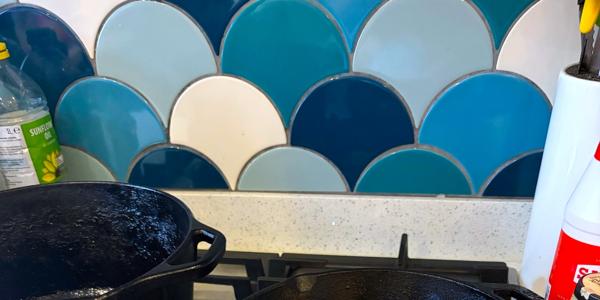
I really like this pattern, and I’ve considered getting it in my own kitchen – but until I can redecorate, I wanted to recreate the effect digitally. I got close a few years ago, when experimenting with circle-based art for the header of this website, but the scales were diagonal rather than horizontal.



I was able to draw the horizontal rows with a small tweak to the original script, adjusting the centres of where the circles get drawn.



Like my previous art in this vein, I’m using varied shades of a single tint colour rather than a discrete palette. This loses the shape of some of the individual tiles, because they blend into a similar shade in the next tile.
I ran another experiment where I used the tint colour as “grout” to add a border between tiles. I like this effect in the lighter tiles, but darker tiles can still blur the edges between shapes:



I think you could make this pattern work, possibly by using an edge colour that doesn’t appear on any of the tiles, but I didn’t pursue the idea further.
Alternatively, I could switch to a discrete palette. If you have more than a handful of colours, the four colour theorem tells us that it’s always possible to find a colouring where adjacent tiles never have the same colour. Notice that’s how Madeline’s tiles behave – she has five different colours, and the same colour never touches itself.
I’ve never tried to use that approach in generative art. The theorem only states that it’s always possible to find a colouring, but you can’t just pick colours at random and expect it to work. Maybe that will be my next project.
If you’d like to try to play with these designs yourself, you can download my code.