Common Bonds (2021)
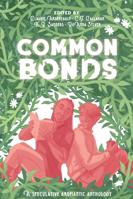
A mixed bag of speculative fiction about aromantic experiences that I wish I’d had more time to read.
This is an anthology of aromantic stories I read as January’s Ace Book Club book. It covers a range of genres and settings, and also quality levels. There were a few stories I really liked and that I’ll think about again, some which are forgettable, and some downright plunkers.
My personal favourites:
- The Aromatic Lovers, which takes the aromatic/aromantic pun and really runs with it. There are interesting ideas about gender and our senses, and it’s a great fit for a short story.
- Asteria III, a sci-fi story with some great conversations between a woman and an AI recreation of her father.
- Half A Heart is a gorgeous interaction between a forest spirit and an elven child, learning each other’s magic and stories.
- A Full Deck is silly fun, and I enjoyed the twist of an incubus who targets asexual people through their romantic attraction.
- Not to Die has a nice form of prophecy magic and the right amount of backstory and plot for a short story.
With a few exceptions, the anthology steers clear of a classic failure mode of queer fiction – explaining an identity with an info dump that sounds more like a Wikipedia page than a human conversation. Most of the stories have interesting characters and plots, although some are a bit overstuffed for short stories.
I dislike the decision to intersperse short stories and poems in the same anthology. The two formats have a very different pace, and reading one after the other was quite jarring. The poems are also distributed unevenly throughout the book, creating further confusion.
I read this in a hurry because I had to finish it for book club, and I might have enjoyed it more if I had more time to sit and reflect with each of the stories. In particular, the connection to the aromantic theme wasn’t always obvious, and I wonder what I’d have seen with more time.
Notes on individual stories
The Aromatic Lovers, by Morgan Swim. In a society which is dominated by detailed scents which convey your identity, Matroise visits Dario, a master aromaticist – partly to seek their affection, partly for a scent that will mask their identity completely. No longer will their gender be discernible by anybody who smells them; they become an aromatic mystery.
This was one of my favorite stories, which stretches the aromatic/aromantic pun as far as it can go. It has interesting ideas about gender and a world where a different sense is dominant.
Voices in the Air, by Vida Cruz. A pair of entertainers who have are fleeing persecution in their home country encounter a river and refuse to cross; terrified of water-related trauma in their past. Local villagers are scared of a monster they believe is stealing young women – and when one of the two entertainers disappears at night, the other discovers the village chief made a bargain with the monster. He traded women for weather, not realising his daughter could be taken. The entertainer sings a powerful song which distracts the monster, allowing it to be destroyed by the spirit of her dead brother.
I found this story very forgettable.
Moon Sisters, by Camilla Quinn. An aromantic werewolf living with their pack gets defensive when Summer, another of their pack, is dumped by their human partner, who was worried that Summer was too close with the pack members. Although the protagonist doesn’t understand romantic attraction, they understand Summer’s pain and jump to comfort her.
This story shows the best aspects of living with all of your friends: the group instantly abandon their plans to look after Summer.
Cinder, by Jennifer Lee Rossman. A disabled princess who’s been trapped by her abusive stepmother hires a Prince Charming through the social media app Cinder, but has to rescue herself when his attempt goes awry. She proceeds to his next job, where she rescues a blind princess and the two of them decide to continue saving princesses together.
I loved all the puns on social media apps, and they’re a great way to do quick worldbuilding without an infodump. The plot was fun and silly, and reminded me of superhero stories – almost more than the actual superhero story.
Not Quite True Love, by Syl Woo. A poem answers an essay question about whether finding true love makes life fulfilling. It questions the definition of love, what it means to make life fulfilling, and points to many other sources of fulfilment unconnected to romantic love. The writer rejects the premise.
This was my favourite poem in the anthology.
Dracanmōt Council of Human Study Report Compiled by Usander Greystart, by A.Z. Louise. A dragon disguises itself as a human to study a medieval city which is besieged by orcs. The narrator befriends a young woman who’s aromantic, and the two of them are captured. In an attempt to save her, the dragon lures the orcs away from their lair, then transforms and attacks them, and resolves to protect to village rather than deceive it.
The dragon as a narrator worked well, because it took a while before I worked out who was speaking. The story uses them to provide an external perspective on what humans are like, how they react to strangers, and how they feel emotions.
Spacegirl and the Martian, by Cora Ruskin. A superhero who can stop gravity realises that her lack of romantic attachments doesn’t mean she’s invulnerable – her supervillain nemesis just kidnaps a barista who’s friendly to her instead. After drowning her sorrows in the hero pub, she sees the villain through the window and realises it’s her twin sister. The two spent time together, and reflect on what makes somebody with powers a hero or a villain.
This was another fun and silly story, which perhaps tried to cram in one too many ideas.
Would You Like Charms With That? by E.H. Timms. Robin and Callie, a pair of “shoulder friends” who run a shop together, talk to Kit, a young aro-ace. They explain how they met, how they look after each other, what it means to be shoulder friends, and how they depend on each other without a romantic relationship.
This story was more tell, less show, and it felt like somebody trying to provide a textbook definition of friendship. It might have worked better if I already knew Robin and Callie, and wasn’t meeting them for the first time in the story.
In the Summer a Banana Tree, by Thomas Shaw Leonard. Apoem in which somebody fondly remembers an old dog. I don’t understand why this is here.
Remembering the Farm, by Thomas Shaw Leonard. Another poem in which somebody remembers their father, maybe? I didn’t understand this one at all.
Fishing Over the Bones of the Dragon, by Jeff Reynolds. A young boy is stolen in the night to a fae world ruled by a cruel queen, where every day is food, drink, sex and fighting. He stayed there for a century, witnessing death and being killed himself, but death just resets the dream with the memory of the pain. Now returned to his parents, he goes on a fishing trip with his father who was similarly taken as a child, and they talk about how it changed them in the slow, silent way that boys and their fathers do.
I liked this story, but the message got a little lost. I think it’s about the cyclical nature of abuse, how the son and the father suffered in the same way. We could have explored this more with the newer arrivals in the fae world, and perhaps spent less time discussing the cruelty in excrutiating detail.
Asteria III, by Marjorie King. Elanor is piloting an experimental FTL spaceship, and talking to an AI recreation of her father, who has Alzheimer’s. They play a lot of chess on the two-month journey, and he pushes her to consider whether she’s playing for the company or playing to win – and it’s her anti-grav system on the line, so she should play to win. She realises the issue with the FTL drive and returns to Earth a hero.
I really enjoyed this story, and it put the right emphasis on character moments over sci-fi plot. The Spaceship makes a good setting and climax, but the conversations between Elanor and her father are what make this story.
A Full Deck, by Avi Silver. A group of demon hunters have to deal with an incubus who’s realised they can ensnare asexual people by going for their romantic attraction. A small team have to team up with a freelancer “Cat the Bastard” to defeat an incubus who’s draining another demon hunter over a particularly involved game of Magic: The Gathering – while the Bastard is trying to conceal the fact that the incubus got the idea from them.
I like the idea of an incubus who goes after asexual people, and the team dynamics are fun. This story gives a good sense of the world without describing it in too much detail.
Half A Heart, by Ren Oliveria. A tree spirit meets an elf child who wants to learn the magic of the forest; humans and elves used to visit the forest long before the world was destroyed. The spirit would exchange stories for magic; it has a limited understanding of emotions but is intrigued by them. At the end of the story, the spirit leaves the forest heart behind (which it was sworn to protect) and replaces it with half the child’s heart.
This is another story that builds the relationship between its characters well, and provides just enough of the world to be convincing.
This reminded me of John Finnemore writing about the final episode of Cabin Pressure, and how his characters had to “graduate” from being sitcom characters. The same is true here – the story doesn’t just peter out, there’s a clear change where they stop being short story characters and go off to have bigger adventures.
Shift, by Mika Stanard. Olivia realises that her roommate Alexandria is a werewolf, then invents a hackneyed game to ask her about it. That becomes the dictionary explanation of aromantic and asexual experiences, and going home to Olivia’s parents who want her as part of the “pack” if she can be trusted with the secret.
This was my least favourite of the short stories, because it fell into the classic trap of providing an infodump about a queer identity instead of a realistic conversation.
Discography, by Ian Mahler. A short poem about being the odd one out, the idea that humans must come in pairs, and not understanding music. Another strange choice.
Seams of Iron, by Adriana C. Grigore. Erin was cursed as a young woman to make things for people and give them away; the story starts when she brings a cloak to Sigrun, a witch. Over the years of the curse, the garments have helped people or healed them. Sigrun is cursed with an iron heart; they talk about loneliness and marriage and finding company in a home. The dual curses cancel out, and they build a home together. When the original witch breaks Erin’s curse, it breaks both their curses.
I liked this story, but it had too many ideas. It’s a clever choice of curses, but they’re wrapped in other layers of world building and plot that don’t really do anything and just serve to confuse the story.
Not to Die, by Rosiee Thor. Ursa is a “knotter” in the Perennial Market, a place where time stands still and nobody ages. She can weave threads and use magic to see the future of couples or connected people. She used to live in the real world, but her apprentice married her brother and then both of them were killed in war; she retreated to the Market to avoid the pain. A nearby flower seller Prima is fascinated by her threads and wants to understand. She persuades Ursa to take her on as a new apprentice, and they leave the market together.
I like the magical element of this one, and it has the right number of ideas for a short story. We learn a bit of Ursa’s history, but we’re not overwhelmed by extra detail.
Busy Little Bees, by Polenth Blake. The protagonist is a bee, a clone of their mother, and a perpetual disappointment as they become more and more different. The story is about them tracking down other bees, the sibling or familial relationship between them, and then some crackpot plan to overthrow the company that manages the cloning and surrogates.
This story has too much plot. It would be enough to explored the relationship between the bee and the mother, or the first sibling they meet – but it becomes a fetch quest of different bees, and then a rushed plot to bring down the company. Less would be more.
The plot also squeezes out the worldbuilding; I don’t understand how this world works.