How They Get You (2025)
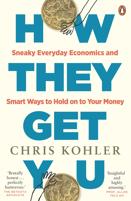
Personal finance with some verbal flourishes.
Chris Kohler is an Australian business journalist, and I picked up his book because I’ve watched a lot of his YouTube shorts. I was hoping for something slightly more in-depth than I got; this repeats a lot of material from the channel, and I don’t think I learned that much that I can use directly.
I did enjoy learning more about Australia and the specifics of the Australian economy – I understand more of what he’s saying now, because certain things he takes for granted don’t apply in the UK. (For example, toll roads seem to be a consistent and aggressive part of Australian driving, whereas I don’t think I’ve ever driven across a toll road.)
Unsurprisingly for a journalist, the book reads very well and is full of lots of nice verbal flourishes. It was a quick and easy read.
Notes and highlights
Most of the business practices described in the book aren’t illegal, they’re just frustrating. Get in the habit of asking “How is it getting to me?” when something seems off, and remember you can push back on these things. You can often get a better deal if you’re willing to ask.
Subscriptions have become the way we purchase things, which is almost entirely for the benefit of companies. They get repeat customers and our data, and rely on the friction of unsubscribing to keep us paying. From page 5:
Repeat business. Great for businesses. Terrible for customers. People should never be brand loyal. They should be quality and cost loyal and completely brand agnostic.
Audit your subscriptions, be proactive about canceling ones you aren’t using, and be willing to churn regularly to get better value.
Food delivery is only really good for the food delivery apps, who take a heavy chunk of the money.
In Australia, customers can pay up to 45% more for their food, and restaurants also get hit with fees. (I don’t have much experience with UK food delivery, but 45% feels high.) The size of the increase is masked by inflation making food generally more expensive, and blurring our sense of how much food “should” cost. Convenience is expensive!
Private motoring is very expensive and a significant chunk of that cost is car loans. When you get a car loan, look out for hidden costs, and look at the total cost of the loan.
Page 31:
Cars – or something that resembled them – were being made here and there throughout the second half of the 19th century. Then Henry Ford sauntered into the sector and blew the whole thing wide open with the invention of the production line and the Ford Model T. The first one rolled off the line in October 1908 and the first car loans were being brainstormed about 10 minutes later.
Loyalty programs are a way for companies to collect data about our spending habits, not to give us rewards. The return rate is negligible and loyalty is overrated.
Superannuation is an Australian system for managing long-term retirement savings. The management fees can be substantial and take thousands off the money you get at retirement. Funds with the highest fees are often the worst performing. Don’t just let investments sit there; move money out of underperforming funds.
Most payments are now card or contactless, not cash. This was a deliberate push – it allows banks to charge more fees, and it reduces the psychological burden of paying for something. Counting out cash gives you a moment to pause and reflect on whether you really want to spend this money, and you feel a sense of pain; that’s not true for card payments.
From page 75:
There is an academic theory called ‘The pain of paying’. It basically outlines that human beings are loss averse. We hate giving something up. Losing a $10 note, for example, would make you more upset than finding a $10 note on the ground would make you happy. And it’s been studied quite a bit.
The ‘pain of paying’ was first used by Ofer Zellermayer in his PhD dissertation back in 1996. He was studying the emotional reactions displayed by people when they pay. Paying for something was previously seen to be purely a rational process: I need this thing, so I’ll pay for it.
But Zellermayer’s research, and that of subsequent studies, found that what’s actually involved is a range of emotions. The most powerful one is pain. We hate handing over money. When we’re at a shop and we buy a sandwich and a drink and hand over a $20 note, the pain receptors in our brains are mildly alerted, according to the researchers. That doesn’t happen when we tap our card or phone. We’re not handing over the cash, so it doesn’t teel the same. There’s no pain.
Black Friday’s historical roots are in the American Gold Rush. Two businessmen tried to keep prices artificially high until they were caught and the president flooded the market with gold, causing a price crash.
Today we should be careful of sales – the way they’re described is often misleading, and makes us think we’re getting a better bargain than we actually are. Advertisers will use targeting to try to get us to buy things we don’t really need.
Mobile data underpins everything we do and it costs a lot of money. Companies use bundles that don’t scale in a linear way, to increase the amount we spend. (I’m just over the 200GB iCloud tier, so I’m paying 3× as much for 10× the data. From page 96:
It’s hard to think of a part of the business world that has changed more in 20 years than the world of mobile data. These days, we can easily burn through 5 gigabytes of data while watching a two-hour movie on our mobile phone. Data has become the thing behind the thing you want to do. You want to watch TV? Data. Go shopping? Data. Talk to your mum? Data.
It’s kind of weird to think that, if you’re reading this book in print right now, you’re not using any data. Unless you’re an audiobook or ebook kind of person: then … data.
Prices can come down when there’s competition. Indians pay a fraction of Western data prices, driven by Jio, who brought down prices dramatically – but it also took a billionaire to bootstrap a new network.
Lottery, sports betting, and gambling are engineered to take money from consumers. In Australia, average spending is now over $1000/year per person. They have strong marketing, and tap into our primal hope that things are about to turn around even though the mathematical odds are heavily stacked against us.
Page 106:
Gambling has been around forever, but what’s changed is how hard it’s coming after you. It’s spent the last tew years on Gambling has moved online and into apps. It’s now inseparably linked to the sports we love to watch. Losses are up. Problem gambling is taking hold of people and taking hold of them younger.
And there’s a simple reason why – marketing.
I was sitting on a panel a few months ago, talking about content, and someone asked me if there were any businesses I thought were doing really good social media and advertising content. Without hesitation, I said, ‘Gambling companies. Sports betting companies, in particular.’
Page 112:
The rules are being worked out – and the heads of the leagues are finding out how their fans feel about gambling advertising – as they go. It’s an arm-wrestle, as legislators try to keep the gambling dog on the leash. In Australia, it’s a gambling rhino and the leash is a shoelace.
Mortgages are an incredible drain on our finances and becoming more so. The traditional 50/30/20 rule is out of the window. A big part of this is rising house prices. Homeowners don’t want their house prices to go down, and more people are homeowners than not, so politicians don’t want to do anything that actually affects house prices. Bank fees also add up. You can often get a better deal by challenging your fees or looking for a bank with a better interest rate.
Supermarkets engage in deceptive pricing games, for example, alternating the price between high/low and marking the low price as a “discount”. What if there is no regular price?
In Australia, the two big supermarkets have eroded customer trust because groceries have become so much more expensive. Meanwhile, Aldi has risen in customer trust. Cheaper shopping builds trust, and that comes down to a simpler business model. Having lots of choice is expensive, and that money comes out of customer wallets.
Real estate agents are salespeople driven by commissions, very similar to other sorts of salespeople – they’re not especially better or worse than other markets. Think about their incentives and how it affects their behaviour. Do your own research on how properties they’ve sold have performed.
Traditional advice about the housing ladder is largely defunct, especially for apartments. There’s a steady supply of new properties, which undercuts demand for existing ones, and selling a property isn’t guaranteed to make you money.
Australia uses auctions to sell properties; you literally go and stand on the street and shout numbers out loud. It sounds incredibly stressful and I’m glad it’s not something we do in the UK.
Home insurance is getting more expensive: a double whammy of increasing weather risk and increasing building costs. Many Australians are underinsured for natural disasters. Insurance companies don’t reward loyalty. Look around for better offers. Remember that insurance comparison websites are also businesses and may give you a not entirely fair comparison.
Buy Now, Pay Later (BNPL) schemes are just a fancy term for credit. They’re a form of debt and they can easily compound. The psychology is quite straightforward: we’re more likely to buy something if we don’t see the full cost up front. This means we spend more.
As with food delivery, BNPL companies are double-dipping: they get consumers with overage fees and high interest rates, and businesses who use them as a payment method. They can charge businesses more than twice what credit card processors charge, because BNPL means more sales.
Cryptocurrency is a volatile investment. It rose out of distrust in big financial institutions after the market crash of 2008. You can kick yourself for not investing in Bitcoin in 2016, but lots of other people put money into cryptocurrency and lost it all. It’s okay if you’re interested in digital currencies and treat it as part of a balanced investment portfolio, but don’t go all in thinking you’re going to make it get big wins.
Shrinkflation is an annoying, sneaky tactic by businesses to spend less, to make products cheaper without increasing the price – that’s the thing we often notice. Pay close attention to unit prices, which are harder to fudge. Some governments have introduced legislation to make unit prices more prominent, which is the only thing they can really do. When consumers complain about shrinkflation, the company’s response is often to bring back the item at its original size, but at a higher price.
Petrol stations assume drivers will schedule their fills based on necessity not on pricing. In Australia this manifests as a “price cycle” where prices go up and down regularly to make it harder to track the average cost.
Star ratings have been heavily gamed by businesses, and they’re now far weaker signals than we imagine. We feel we’re making an informed choice, but ratings tell us very little.
Drip pricing is advertising a low price upfront, and then making you purchase lots of add-ons (like fees on air travel). It’s incredibly annoying and relies on our attraction to prices that look low. In theory, competition means we can go to another vendor, but often drip pricing is used in contexts where we have no other choice.
Tariffs were considered to be pure theory for decades, because the practical effect is to hurt the economy, put up prices for consumers, and cause trade wars. It happened in the Great Depression and it happened again during the Donald Trump presidency. They weren’t discussed much, because nobody rational would pull that lever.
The global manufacturing chain is too well integrated; parts cross borders dozens of times, and tariffs don’t bring about the boost in local manufacturing and economies you might imagine they do.
Australia has an aggressive and confusing network of toll roads, so even a relatively short drive can cost you tens of dollars. People who moved away from the city for cheaper housing are paying that cost back in toll roads.
Modern games are designed to extract money from us, and gaming companies often make more money in the add-ons than in the purchase of the game itself. Loot boxes use the same psychological tricks as gambling, and use in-game currency to fudge the amounts involved.