How to Invent Everything (2018)

A history of human civilisation and its key inventions, packaged as a guide for the wayward time traveller.
This is a book with a fun conceit: you’re a time traveller stranded in the distant past, and this guide will help you bootstrap something approximating the civilisation you left behind. It touches on major areas of human civilisation like agriculture, textiles, healthcare, and communication. The information is delivered with a touch of whimsy, and is detailed enough that I believe a time traveller might actually be able to use this.
The fictional aspects are really a way to discuss the history of human invention and civilisation, which the book does in great detail. I found it a little too exhaustive in places – the list of edible plants and crops became a bit of a slog – but overall it’s a good mix of information and fun anecedotes.
I read it cover to cover, but in hindsight it might be better enjoyed dipping into specific sections to learn more about key inventions in that area.
Notes and quotes
We only know of two occasions when writing was invented from scratch rather than being copied from another civilisation; there are another two instances where it’s unclear if it was invented or copied.
Modern species of corn and wheat now rely on humans to survive; they can no longer reproduce independently.
I want to read a story about this heist (P40):
Weight we’ll base around the kilogram, which until 2019 CE was still tied to actual prototype kilograms: physical masses of platinum safely stored worldwide in nested bell jars so that humans can point to it and say, “A kilogram is however much that hunk of platinum weighs.” There was the canonical copy—stored in France—and dozens of duplicates placed throughout the world for both convenience and safekeeping: after all, you don’t want anyone stealing the only kilogram in a dramatic and elaborate heist, leaving the entire world unsure of precisely how much one kilogram weighs.
The same page hints at a distressing problem with the canonical weight, which is apparently still unsolved:
Different kilograms stored throughout the world—even those made from the initial batch of forty cast in 1884 CE—were becoming different weights, drifting ever so slightly apart over time-and until time travel was invented, we didn’t even know why. It gets worse: since the measurements comparing the weight of prototype kilograms are all relative to one another, this left open the possibility that all kilograms were gaining or losing mass, and some were just better at it than others.
At the start of chapter 5 “Now we are become farmers, the devourers of worlds”:
Think of [plants] as free technology: machines you can use, even by accident, to transform the inedible dirt around you, the boring light above you, and the tedious water that falls from the sky into all sorts of useful materials, medicines, chemicals, and foods your civilization requires. If we did not already have plants, we would think they are magic. But they are everywhere and evolved before we did, so most of us think they’re pretty boring.
Chapter 6 “What will other humans be eating” describes another terrifying example of Australian wildlife:
Some plant toxins are irrelevant (apple seeds contain cyanide, but you’d have to eat tons of them to be affected), while others are brutally horrible. Among the worst is the Australian stinging bush, also known as the “suicide plant” after stories of both humans and animals killing themselves to escape the pain it produces. When you touch this plant, the neurotoxin-coated hollow hairs covering it pierce your skin, causing an unbearable pain described as similar to being burnt with acid and electrocuted at the same time, and the only treatment is to soak the affected area of your body in hydrochloric acid and then remove the plant hairs with tweezers—carefully, because if they break off inside the skin, that only increases the pain.
At the end of a section on salt production, page 150 mentions the public health implications of iodine, which I’d never heard of:
Iodine is an element that, like salt, is necessary for human life, and whose absence causes fatigue, depression, goiters (neck swelling), and, if the absence occurs during pregnancy, intellectual disabilities in the child. It’s abundant in seaweed and in both saltwater and freshwater fish, but can be more rare inland. In the modern era we spray iodine on salt, thereby ensuring adults get, on average, their 0.15mg of iodine recommended per day no matter what they eat. Salt is used as the iodine delivery vector for two reasons: it doesn’t go bad, and people tend to eat a predictable amount—nobody, for example, sits down in the morning and decides to eat a 5kg pile of salt for breakfast. lodized salt is one of the simplest and cheapest public health measures humans have ever come up with, and it enhances both physical health and intelligence at the same time: when iodized salt was introduced across America in 1924 CE, intelligence scores in iodine-deficient regions went up by an average of 15 points. And while you probably won’t be producing iodized salt for a while, if you ensure the members of your civilization have access to foods high in iodine like fish, shrimp, seaweed, cow’s milk, chicken eggs, and nuts, then they—and you—will do just fine.
Page 173 describes the history of Venetian glassmaking:
Italian glassmaking kilns sometimes caused fires—a particular danger when most buildings were made of wood—and so the government of Venice banished all glassmakers to a nearby island. While this was intended as a safety measure, concentrating all glassmakers together led to an explosion of talent and shared expertise, which allowed glassmaking to advance quickly, leading to the rediscovery of the “burn seaweed and add its ashes to make clear glass” trick. Even clearer glass can be made by a 10 percent to 30 percent concentration of lead oxide, which produces a glass (known as “crystal glass”) that’s very refractive and pretty but can also give you lead poisoning.
Page 219 has a sad story from the history of medicine, and a psychological phenomenon I’m familiar with but didn’t know had a name:
This idea was first proposed by a Dr. Ignaz Semmelweis in 1847 CE. He worked at a hospital with two maternity clinics: one staffed with midwife students, and the other with medical students who performed autopsies before assisting in births, all while never washing their hands. After noticing the mothers at the med student clinic would get vaginal infections so horrible it killed them as much as 30 percent of the time (compared to around 5 percent at the midwife clinic), Doc Semmelweis introduced a hand-washing regimen. Death rates from infection dropped to 1 percent in both clinics. At the time, the causes of disease were considered to be unique to each patient, and the notion that disease could be prevented simply by washing hands was thought extreme. After being dismissed from the hospital, Semmelweis wrote letters to other doctors urging them to wash their hands. and when that failed, he wrote new letters denouncing them as murderers. For his efforts he was committed to an insane asylum in 1865, where he died fourteen days later—from an infected wound he contracted after being beaten by guards. The idea that cleanliness could stop infection didn’t gain acceptance until twenty years after he died—when we finally realized germs were a thing—and today, the way humans can quickly and almost reflexively reject information that contradicts their established beliefs is named the Semmelweis reflex.
Page 332 describes an example of how once-known knowledge was lost because nobody wrote it down (emphasis theirs):
The synthetic blue pigment discovered in 1704 CE was not actually the world’s first artificial pigment! It was the first one Europeans came up with but back around 3000 BCE the Egyptians—also annoyed at how expensive grinding up lapis lazuli was—managed to produce an artificial version of the color by combining under heat some quartz sand, copper, calcium carbonate, and alkaline ash. This technique was used for thousands of years, but by 400 CE, every single person who’d known how to make it had died without telling someone else the technique or writing it down, and the knowledge of how to make an inexpensive substitute for one of the most expensive colors on the planet was lost. Everyone: this is what happens when you keep really important knowledge a secret and then die.
Page 342 has a good explanation of wind instruments, and an illustration that helps me understand trumpet valves in a way I never have before:
Wind instruments are a bit more complex to invent: here you’re relying on the vibration of air inside a resonating tube to produce noise. You alter the pitch of your noise by changing the length of that column of vibrating air, either by having a bunch of different tubes (as in a pan flute, having a slider built into the tube (trombones, slide whistles), or by pressing valves to reroute air through additional passages to create a longer tube (trumpets, tubas). These valves look like this:
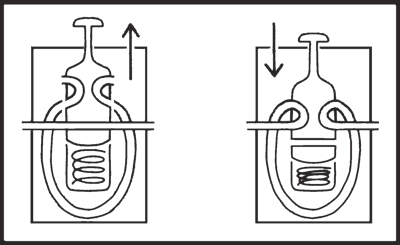
Valves for musical instruments Page 348 describes the history of piano keys, a story I hadn't heard before:
You can see that even though we’ve got twelve notes in an octave, some are on white keys and given lettered names (A, B, C, D, E, F, G) while others are on black keys and get labeled as flats or sharps (A♯, B♭, etc.). This is for historical reasons: early pianos used a seven-note scale that only included the lettered notes, so when the other notes that brought us to twelve were bolted on later, it was as tiny black keys.