Lights of East Anglia (1983)
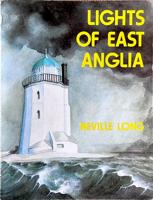
A detailed account of East Anglia’s lighthouses and their history.
I think I got this book a few years ago, when I was visiting Hunstanton on holiday. I’ve stayed in the area several times and seen a few of the lighthouses, but I didn’t know any of the history.
This book is a detailed account of their history, drawing together many sources to provide a timeline of lighthouses and similar towers in the area. Most of the places were new to me, but in the chapter on Hunstanton, I actually recognised several of the ruins because I walked past them.
I’ve left detailed notes below, but I think what I’ll really take from this book is the broader shape of how lighthouses were historically managed. I’d never really thought about who pays for lighthouses, except that it’s probably something to do with a government-funded coastguard. As the book explains, lighthouses were historically a private operation run for profit. Many lighthouses also came in pairs – a low light and a high light – which makes sense, but is another thing I’d never thought much about.
I enjoyed reading this, and I learnt a lot about a period of history about which I previously knew almost nothing.
Notes and highlights
Introduction
Today we think of lighthouses and maritime rescue as a humanitarian, altruistic operation. This wasn’t always the case – it took a long time for Britain to realise that coastal lights were important for nighttime navigation, and longer still for it to be organised coherently. Lighthouses didn’t appear in Britain until the 17th century.
Operation of lighthouses was nominally managed by Trinity House. In practice, they were more responsible for managing permits granted to private lighthouse operators, who ran lighthouses as a business venture.
Operators would collect tolls from local sailors in exchange for the service.
Page 1 explains how historical sea maps differed from the ones we use today:
The first primitive sea charts did not show the coastline from directly overhead, as is the case today. Instead they viewed it from an oblique angle, so that features such as cliff-faces, low-lying marshes, church spires and groups of trees were all identified. Nightfall rendered all these visual aids ineffective, and the colliers were left to grope their way uncertainly through inshore passages that were shallow, treacherous and, worse still, unlit.
Page 6 explains that the reputation of lighthouses as a smugglers’ paradise is far from the truth – all those children’s mystery stories lied to me!
Due, no doubt, to their isolated situations lighthouses feature prominently in smuggling yarns and local legends as hiding places or clearing houses for contraband cargoes. In reality the situation was quite different. To a revenue man patrolling the coast in the bitter cold and dark of a winter’s night, what could have seemed more inviting than the beckoning glow of a lighthouse? The prospect of a thorough warming before a cheery fire, an exchange of local gossip with the lightkeepers and the likelihood of a drop of something to keep out the cold, all or any of these were attractions too tempting to let go by. In consequence lighthouses drew revenue men like moths to a candle, and no self-respecting smuggler would care to be seen within miles of one.
Chapter 1: Cromer
The area around Cromer is heavily affected by coastal erosion, and lighthouses and villages have both disappeared into the sea.
In the late 17th century, Sir John Clayton want to build a chain of lighthouses, including one at Cromer (on a now-gone area of land called Foulness). He became locked in a battle of wills with Trinity House, and below several of his lighthouses were built, only one was ever operational.
In the early 18th century, Edward Bowell tried again and was successful. He built a Cromer lighthouse powered by a “close coal light”, an enclosed coal-burning fire that wasn’t directly exposed to the elements.
The records of his lighthouse survive thanks to the compiled accounts of John Whormby; many of Trinity House’s original records from the period have been lost due to fires and World War II bombings.
In the late 18th century, the lighthouse was converted to oil, and became one of the first lighthouses to have an intermittent flash.
In the early 19th century, Foulness was collapsing into the sea, and it was clear that the lighthouse would follow. The replacement was built in 1832, and stands to this day. The circumstances of its construction are a bit of a mystery – it uses heavy stone, far more expensive and durable than required for its coastal location, but the reason why has been lost to history.
On 7th December 1866, the cliff collapsed and took the old lighthouse with it.
The new lighthouse was subsequently upgraded to use gas, and later electricity.
Page 30 explains that Cromer was an outlier; I wonder if that’s still true today.
In this age of automation it is the only lighthouse on the coast of East Anglia to be watched round the clock by a full complement of keepers. Its position on the cliffs gives it one of the highest elevations of any British lighthouse, the focus of the light being 274 feet above sea level, enabling it to be seen over a distance of twenty-three miles on a clear night.
Chapter 2: Winterton
Winterton and Winterton Ness were especially dangerous areas for shipping.
The first plans for a lighthouse came in the early 17th century, supported by James I but opposed by Trinity House. While the private proposal was stalled, John Meldrum purchased a stake and the lighthouse was built in 1921. There was an inquiry involving Meldrum and Trinity House, overseen by the Attorney General.
Meldrum transferred his grant to Alderman Gerald Gore in 1634, and in 1637 the Winterford grant was consolidated with the Orford Ness grant (also previously set up by Meldrum).
In 1677, the coastline changed, and Trinity House built their own lighthouse – now there were two lights covering the same area. The lighthouse had to be moved within a few years, because of coastal erosion.
Various further towers were built my private interests and Trinity House jockeying for position. In the mid-19th century, all of them came under Trinity House due to new laws allowing them to perform compulsory purchases.
Maram grass was used to resist coastal erosion in the Winterton area, and was successful in doing so.
A story on page 33 explains how lighthouses can disappear from the historical record:
In 1600 the Trinity Brethren carried out an extensive survey of Yarmouth Roads. As a result, two candle lighthouses were erected at Caister, a few miles down the coast, but no reason was found for any lights at Winterton. Caister lights have long disappeared from the scene, leaving little evidence that they ever existed. One reference to them still survives in the form of a letter addressed to a certain Mr Hill appointing him lightkeeper in 1628. He was instructed “to live at Caister in Norfolk, and to exhibit in either lighthouse three candles of three to the pound which are to be lighted immediately after sunset and continue them burning until fair day.”
Page 47 has a similar story about the difficulty of pinning down historical events:
The precise date at which the Thwart Lights were discontinued is not altogether certain. They were depicted as working lighthouses on a map made in 1803,17 and they appeared also on a survey made in 1817 in preparation for the first edition of the one-inch Ordnance Survey series. For various reasons the issue of this map was delayed for almost twenty years, making it necessary for the original work to be updated prior to publication in 1837. Among the amendments made at this time was the deletion of Winterton Ness Lights. As near as can be said, then, the two Thwart Lights were discontinued at some time between 1817 (the date of the preliminary field survey) and 1828 (the date of Lord Braybrooke’s extended lease). White’s Directory of Norfolk, first published in 1834, records that the two derelict towers on the Ness were demolished about 1830.
Page 50:
At daybreak one morning in the autumn of 1921, Winterton Tower Light was extinguished for the last time, so bringing an end to more than three centuries of sea lights displayed from this remote and notorious point of the coast. On no fewer than four occasions during that time, the Trinity Brethren had established lights here, and as many times again had relinquished them, twice under duress and twice of their own accord.
Chapter 3: Orford Ness
Orford is a place where river “bends backward” before joining the sea. This unusual geography meant it could be a place of shelter for ships to seek refuge.
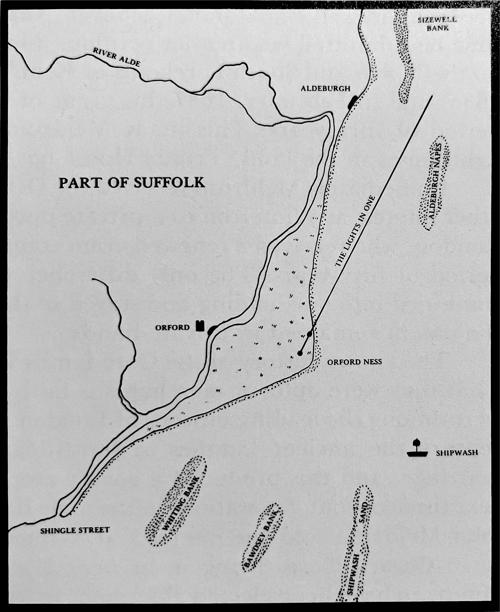
Heavy storms in 1627 led to demand for a lighthouse. Sir John Meldrum applied for a grant, which he got an 1637, but he gave it and the Winterton grant to Gore. (The book explains there are multiple goals with the same name; this chapter is very heavy on family history.)
Alderman Gore built two lights: a High lighthouse which was in land and on stable foundations, and a Low lighthouse which was closer to the sea.
When the grant expired in 1687, it passed to Edward Turnour. Because of the remote and inaccessible location, the lighthouses were poorly maintained, and frequent complaints under Gore because constant under Turnour. The lighthouses fall into a state of disrepair.
Page 60 recounts an especially comical excuse for the lighthouse’s condition:
The minuted proceedings of the Trinity House Court, and the Turnour family’s correspondence preserved in the West Sussex Record Office at Chichester, show that under Sir Edward Turnour’s ownership such complaints became almost constant. In October, 1688, the two agents, Thomas Willes and Thomas Wall, sought to defend themselves against allegations that the lights were ill-kept and frequently unlit by informing Sir Edward that “the east winds make the sea darken the light” – whatever that was supposed to mean.
The lease passes to Ralph Grey in 1720. Turnour tries to fight the change and owns the land underneath the lighthouses, but his own financial mismanagement has weakened his position and he is unable to meaningfully protest.
Grey passes the lighthouses to his nephew Henry Grey, who’s even less a businessman than Turnour. After financial ruin and faking his own death, Henry Grey’s affairs are largely taken over by his wife, Elizabeth Griffin. Elizabeth is determined to use her position to improve the standing of the Griffin name. Through a series of inheritances and name changes, she accumulates wealth and status for her preferred nephew, including the lights at Orford.
The Low lighthouses are repeatedly destroyed, some by coastal erosion, others by fires after the switch to oil. By 1732, there have been five such towers at Orford.
The chapter dives deep into the family tree, tracing the various private owners over the years.
While discussing one of the owners, Lady Portsmouth, the book repeats that lighthouses were primarily a for-profit venture, very different to how we see them today (page 75):
Lady Portsmouth’s tenure of the lease had been routine and uneventful. To her the lights were no more than a business asset, to be managed on her behalf by those retained to do so. They made a sizeable contribution to her income, but beyond that Lady Portsmouth’s interest was impersonal and quite detached. She was by no means exceptional, it was the way of lighthouse owners in the eighteenth century. You erected a lighthouse and it earned you a profit. So long as that state of affairs continued, the fact that your lighthouse prevented a dozen shipwrecks or preserved a score of lives was highly satisfactory, but somewhat incidental to the main objective.
The final private owner was Richard Neville, 3rd Lord Braybrooke. Among other things, he edited the original edition of Samuel Pepys’s diaries, and omitted several passages in which Pepys criticised the concept of private lighthouse ownership. The lighthouses then passed to Trinity House.
When the Low lighthouse collapsed (again!), it was replaced by Southwold lighthouse further along the coast.
Page 85 alludes to mysterious history of military applications for the site:
With the electrification of the lighthouse shortly after the Second World War, the keepers were withdrawn and the station became automatic. Throughout the war years strange and secret things took place on Orford Ness. It was here that the first experiments were conducted in the use of radio direction finding, while at nearby Bawdsey Manor there was established the first of Britain’s operational radar stations. Ironically, Orford lighthouse stood silent witness to the birth of these revolutionary beams which were soon to relegate it and all others of its kind to a role of secondary importance. Since the war Orford Ness has remained under strict military control, with access forbidden to all unauthorised persons. During these years the lighthouse has continued in service without interruption. Boldly striped in red and white, it stands aloof on the furthermost point of the Ness, its white light flashing at five-second intervals.
Page 85 also summarises the history and potential future:
Nearly two centuries have passed since John Griffin Griffin built Orford tower. With the exception of Happisburgh, which dates from 1791, Orford is the oldest lighthouse on the east coast. When first built it was separated from the front lighthouse by a distance of 1,439 yards. Today the sea is perhaps 200. yards from it. That may seem a respectable distance, but to the North Sea, which has, in the past, removed 400 yards of cliff in a single night and has swallowed villages in a matter of years, two hundred yards of loose, unstable shingle is a slender barrier indeed.
Chapter 4: Lowestoft
The first lighthouse at Caister and Lowestoft was built by a private individual called Bushell, but the exact date isn’t known. The Trinity Brethren took over Caister in 1600 and Lowestoft in 1609.
The lighthouses were replaced several times in the 17th century for a variety of reasons:
- damage from the weather
- surrounding buildings blocking the light
- their changing role
What started as coastal navigation lights became something that was used for navigating far out at sea, and the light had to be upgraded to compensate. The lighthouses also experienced growing competition. Sir John Clayton built a light at nearby Corton, much to the dismay of Trinity House.
Samuel Pepys took a keen interest in maritime affairs and criticised others for their lack of interest and the idea of “for-profit lighthouses.” In 1676, he was elected for a one-year term as Master of Trinity House. He rebuilt the upper lighthouse, moving it further up the cliffs to a more elevated position. A year later, a lantern was added to contain sparks from the fire, after concerns from towsnfolk who remembered a catastrophic fire six years prior.
Clayton tried to protest because his light at Corton was built but not bringing revenue, but Trinity House didn’t budge. They temporarily made the Lowestoft lights free of tolls in a move to undercut him.
The low light was discontinued unexpectedly in 1706 (probably because of the sea) and replaced with a movable tower in 1730. It was rebuilt again in 1779 because of decay, and again in 1803 (because of sea scouring), and again in 1832 (with a brick foundation).
Meanwhile, the lighthouse was starting to become dim compared to the lights of the surrounding town, and homeowners had to shutter their sea-facing windows to prevent light leakage!
In the late 19th century, the Lowestoft High Tower was prepared for electrification, but it was replaced by paraffin at the last minute. Electrification eventually came 70 years later, in 1936.
1894 saw the final move of the low light before the construction of coastal defences. This was good for Lowestoft, but bad for the neighboring village of Pakefield, which suffered heavy damage as a result. The low light was discontinued in 1923.
Page 88 explains that Lowestoft Ness is the most easterly point in Britain, but it wasn’t always that way:
The first reliable survey of Suffolk was that undertaken by Christopher Saxton in 1575. The resulting map showed the coast to be dominated by Easton Ness, which constituted at that time the most salient point on the east coast. Like its counterpart at Winterton, this promontory suffered extensively over the years from erosion, and to the less-prominent Lowestoft Ness fell the distinction of becoming the most easterly point of the British Isles. For the greater part of three centuries Lowestoft Ness was itself subjected to severe tidal scour, until in 1903 the construction of a concrete sea wall between Pakefield Cliffs and the North Denes finally brought the process to a halt.
From page 109:
Historically, Lowestoft has the distinction of being the oldest established lighthouse station on the coasts of Great Britain. From this point, at the easternmost extremity of the British Isles, a light has shone out every night without fail for more than three hundred and seventy years. The only exception to this occurred during the war years when, in common with all lighthouses, the light was displayed only for brief periods, predetermined by the Admiralty, to aid a passing convoy or a flotilla of naval craft.
Chapter 5: Hunstanton
The Wash gets silt and mud from rivers in the Fens, and sand and silt from the sea. This means it’s full of sandbanks, and at extreme low tides, it’s as much dried out as covered by water.
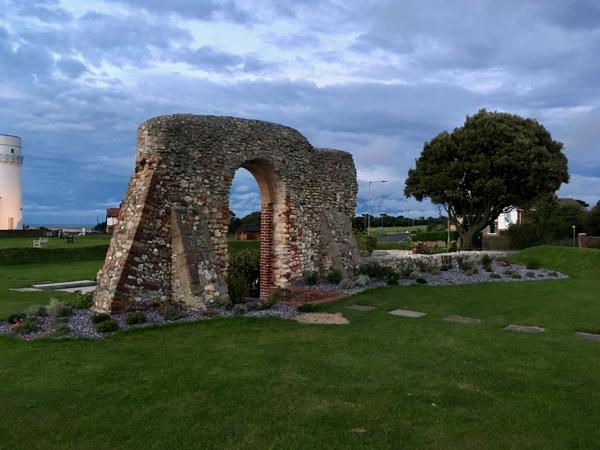
Around 1272, St Edmund’s Chapel was built, named after Edmund, the Saxon king who came from Germany to claim East Anglia. Candles in the chapel window served as an unintentional navigation light, and the Hunstanton lighthouse later became known as the Chapel’s Light when the chapel fell into disrepair.
I compared some old holiday photos to some photos, and it confirmed my suspicion – I visited the ruins of St Edmund’s Chapel on holiday in 2017. You can just see a newer lighthouse on the left-hand side:
In the mid-17th century, around 200 merchants signed a petition asking for a lighthouse on the Hunstanton Cliffs. Their goal was to improve navigation for ships entering the port, the trading port at Lyn.
A quote from the petition mentions a proposed toll of “eight pence upon every 20 chalders of coals”, which is a unit I’m unfamiliar with. Chaldron is a measure of dry volume, primarily used for coal, and like many historic units, the exact quantity varied from place to place.
Trinity House tentatively approved the application, trying to pigeonhole it as more of a local light than an aid to those far out at sea.(The current master also had plans to build his own light after his term ended, and so didn’t want to oppose private applications too strongly.)
The merchants were usurped by John Knight, a staunch royalist and brother-in-law of a local merchant, Edward Bodham. He got the patents to establish lights in his own name, which were built in 1665 and shortly thereafter passed to Bodham.
After a series of inheritances, revenue was being sent to Gartrut Bodham, daughter-in-law of Edward and his son’s widow. It took some subterfuge to renew the grant this time. Trinity House didn’t realize that money was going to Norway, or they surely would have declined!
A devastating fire in 1777 forced a total replacement of the tower, and the then-owner hired Ezekiel Walker to construct the light. Walker had written papers on optics and designed a series of reflectors to focus the light and create a far brighter beam than was available previously. This technique is called catoptric lighting.
After the next lease renewal, the owner sold it on the open market and got a good price – it was a well-built tower with many years remaining. The next owner wasn’t so lucky because they hit the time at which Trinity House began forcibly acquiring private grants, and although the structure was impressive, low tolls meant they got a low price.
Once Trinity House acquired the lighthouse, they replaced the old timber structure with a brick building that still stands today. The new lighthouse had a red beam 1 mile wide to illuminate the Roaring Middle. The rest of the beam was white.
More lights around the wash made Hunstan redundant, but the outbreak of the First World War delayed its closure. It was used as an Admiralty listening wireless station to intercept German messages.
The lighthouse was shut down in 1921, used as an observation post in World War II, and then became a residential property.
I enjoyed this description of the lighting mechanism on page 121:
A second reference is to be found in Armstrong’s History of Norfolk, published about thirty-five years after Whormby’s account was written. Describing the new lighthouse with its revolutionary light of oil, which had recently come into service at Hunstanton, the writer makes a significant reference to its predecessor:
“By this construction the light is constant and certain, whereas the seamen were sometimes obliged to awaken the old gentleman at the former lighthouse with a shot, to put him in mind that his fire wanted blowing.”
Besides being amusing, that description is highly informative, since the fact that the fire needed blowing at all indicates that it must have been closed in.
Page 122 has an example of what I liked about this book – the author has done the research to disambiguate similar or identical names:
James Everard is described in Hillen’s History of the Borough of King’s Lynn as a wealthy banker, but this statement is discredited in Calvert’s History of Hunstanton Lighthouse, published in 1939. This exhaustive genealogical study of those connected with the lighthouse provides evidence to show that Hillen was confusing Everard with later generations of the same name, and that the banking partnership of Everard and Blencowe did not come into being until 1826. Instead, the author identifies James Everard as the Vicar of Middleton, a village about four miles from King’s Lynn.
Chapter 6: Harwich
Harwich Lighthouse was built by Sir William Batten, man disliked by Samuel Pepys. Batten had been a recent master of Trinity House and was now in the business of building private lighthouses. Pepys saw it as a sign of corruption.
Batten already had a long naval career and just wanted to build a lighthouse wherever he could get a grant. Harwich was convenient, not personal.
He asked for a grant in 1664, which was approved by Trinity House. This was about 18 months after Hunstanton, at which time Trinity House was seemingly unconcerned with private grants. Why? The recent precedent and the lack of threat. Neither Hunstanton nor Harwich was considered important enough to affect the profits of Trinity House.
Batten’s ownership was bad for the people of Harwich and for Trinity House. He built inadequate lights, charged a toll at sea, and kept the profits privately, where the local corporation had hoped they would see some of the benefits. (This feels resonant with the construction of data centers in 2026.)
At one point, Samuel Pepys was elected MP for Harwich, in the hope he might recover some of this revenue. At one point, he had a cunning plan to demolish one lighthouse and construct a decoy during the Dutch invasion, which never came to pass. But he did nothing because there were 40 years left on the grant, and he was kicked out at the next election, marking the end of his political and public life.
In 1696, Sir Francis Compton made an unusual bid to renew the grant, despite being more than 30 years in advance and not being connected to any of the existing shareholders, who were now spread thinly over distant family relatives. His application was almost approved, and only withdrawn when the price proved to be higher than expected.
One of the relatives consolidated the many shares of the grant into his own name when he renewed the grant. The lighthouse was then rebuilt on a subsequent renewal and passed to Trinity House in 1836.
Once again, changes to the coastline would render the lighthouse ineffective. This time, it was heavy mining for cement stone at the base of the cliffs, which changed the shape of the coast and made the lighthouse misleading.
In 1863, the two lighthouses were replaced with a pair of lights at Dovercourt, a mile down the coast. These new towers were structures suspended on metal legs.
In 1917, the Harwich Harbour Board took over and replaced the lights with a series of lit buoys showing the way into the port. The older towers are still in use, including by the local corporation (finally!), while the newer towers on metal legs are abandoned and gradually decaying.
Postscript
Today, the lighthouses maintained by Trinity House are regarded as among some of the most well-maintained in the world. Lighthouses have modernised with more automation and the use of helicopters rather than boats for access, but their role as a navigational aid is secure and will continue for many decades to come.
Page 160 talks about the role of automation, and just how automation on my computer isn’t just about saving time, so automation in lighthouses isn’t just about saving money:
Like most large organisations, Trinity House had to make concessions to the push-button age, and in some respects it was a pioneer in the field of automation. It was one of the first to perfect mechanisms sufficiently robust and reliable to function remotely and unceasingly for months at a time. Automation is normally an economy measure aimed at cutting costs by reducing the staff on the payroll. Trinity House was less concerned with costs than with posts, which it was finding ever more difficult to fill due to the demanding and anti-social nature of the work involved. As jobs ashore became more plentiful and pay scales more attractive, fewer personnel leaving the Navy or the trawler fleets, traditional recruiting grounds for Trinity House, were prepared to be incarcerated for weeks on end in a stone tower or be buffetted night and day aboard a ship that went nowhere.
The final paragraph on page 162 was written in 1983, but still rings true today:
Nowadays, when navigational aids are based on radio waves rather than light beams, doubts are sometimes expressed over whether the future still holds a place for the lighted seamark. The fact is that however effective modern electronic systems may be, and regardless of how sophisticated they may yet become, they are nothing more than aids to navigation, just as lights and seamarks are aids. Each has its limitations; neither can hope to be totally foolproof and therefore the one must exist in support of the other. This being so, it is highly unlikely that the coast of East Anglia, which witnessed the birth of lights and seamarks, or indeed the coasts of Great Britain as a whole, will ever be allowed to fall into darkness again.