Love Expanded (2025)
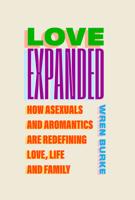
An intersection between ace/aro experiences and broader experiences of love and relationships; it’s a mix of queer theory and sociology.
This book explores asexuality, aromanticism, and the broader ways we love and relate to each other. It’s more in-depth than a typical “Asexuality 101” primer; instead of defining basic terms, it assumes some familarity and weaves a narrative with a diverse range of perspectives and lived experiences. We’ve read several books for Ace Book Club that try to bring in other perspectives, and I found this more successful than the others.
Somebody descrbied this book was “a collection of windows” into other ideas, which feels right. It touches on friendship, legal protections, race and culture, parenting, living arrangements, and more – areas where aspec experiences collide with wider society. It never goes into depth on any one topic, but illustrates what non-traditional relationships can look like with real examples.
Most ace/aro non-fiction feels niche and difficult to recommend if somebody’s not interested in those specific queer experiences; I feel Love Expanded could appeal a wider audience. It uses aspec experiences are a lens to discuss human connection as a whole, rather than as an isolated subject.
There’s an overlap here between queer experiences and society more broadly. The author’s own biases and age shine through, and I don’t think they’re a professional sociologist, but it still made me wonder if I’d enjoy reading more formal sociology.
Notes and highlights
Chapter 1: Love Expanded
Starts with a discussion of Holmes and Watson, and how the author desired a friendship as close as theirs; that was more appealing than a traditional coupled relationship.
Society prizes romantic and sexual relationships over friendships, in attitude and economics. It doesn’t have to be this way – alternatives are possible, and can make you happy.
Some historical context, reminding me of Greek attitudes towards gender fluidity (page 3):
This mentality [that a partnered romantic and sexual relationship is the normal end goal of human life] is an ancient one. In 385 BC, the Greek philosopher Plato wrote his Symposium, a philosophical text that posited the idea that, once, all humans resembled two people stuck together, with eight limbs, and a head with a face on each side. When the gods cut them in half, humans were left to seek their missing other piece. ‘Each of us is a matching half of a human being, because we’ve been cut in half like flatfish, making two out of one, and each of us is looking for his own matching half.’ Those who had once been male became men who loved men; those who had once been female women who loved women; and those who had once been androgynous went seeking opposite-gender partners. That’s refreshingly inclusive (although the welcoming of same-sex love isn’t surprising for an Ancient Greek). But it also gives us a message that, although appearing to be romantic at first glance, it has another, colder, implication. All of us are fundamentally broken. We are all incomplete, until we find the one person who can make us whole.
And a passage on ace joy, a topic I always enjoy (page 18):
For me, aroace joy is lying on my back beside my best friend, my head tucked against her shoulder, talking about memes and life and knowing that this is the deepest, truest bond I’ve ever known. It’s making a playlist of songs, and only realizing later with a laugh that I unthinkingly filled it with songs that have nothing to do with romance. It’s the grin of the other person wearing an ace or aro flag at Pride. It’s in being able to speak to my fellow aspecs and say yes, you understand. Yes.
Chapter 2: Not the Only Story
The traditional queer story is coming out, but this captures only a very narrow slice of the queer experience. Coming out as aspec is often met with disbelief, and there’s no way to do it casually. (Unlike, for example, a woman mentioning her wife as a subtle way to mention that she’s not straight.)
The aspec community is centred around online spaces, and predominantly white. A common bit of advice is to cut off an unsupportive family, but in non-Western cultures family support goes a lot deeper, and the community doesn’t always acknowledge how difficult it would be to cut off one’s family. From page 37:
If the queer community is not making room for people like Elias and Afana, why would they want to come out? Why would Afana want to jeopardize her relationship with her family? ‘The LGBT community is not a refuge for me,’ she says. ‘But I will always have my family on one side.’
Coming out is not the only story; we can tell other ones.
Chapter 3: ‘Something So Cold About Him’
Sexual normativity and amatonormativity. Sexual and romantic attraction and partnered relationships are treatred as good, obvious, unquestionable.
Fictional characters who are aspec are often depicted as “cold” or immoral. Truly chilling villains aren’t cold and alien, they’re people like us (page 65):
Perhaps that is how we should portray fictional villains, if we really want to make them seem inhuman: show that they are capable of both callous cruelty and real love. Show that they can love other human beings, and want them to be safe and happy, but that they choose not to when those other humans are not personal to them. They choose not to care when their personal gain is on the line. This is the reality of the world. When we tell the fiction that ‘evil’ people are incapable of true feeling, we comfort ourselves. Oh, well, we think, I could never be like that politician I hate, or that celebrity who abused a child, or that awful figure from history, because I am capable of love. In doing so, we ignore our own capacity for cruelty. All of us have the potential to do terrible things. The difference is not the capacity for romantic love; it’s the conscious choices we make not to act in certain ways.
And applying that to a specific character from a now-disgraced franchise (page 74):
The problem is how romantic love, in these examples, excuses or forgives continued bad behaviour; how romantic love alone catapults them into being a hero. Snape, a regular abuser of his students, is ‘the bravest man [Harry] ever knew’ by time of the epilogue. It’s in the implication that no one who can love the way Snape does can truly be bad, like the loveless Voldemort. Anyone capable of love must, at heart, be good.
These attitudes hurt aspecs and allos alide; for example, women who stay with an abusive husband because they believe he can be redeemed through their love.
The book is incurious about where this normativity comes from; we discussed it at book club. These attitudes didn’t arise in a vacuum; they’re because leaders were encouraging people to get married. This was for property and labour reasons; the idea of marriage based entirely on love is a relatively recent phenomenon.
Chapter 4: Not Opting In
Gender roles and expectations are deeply tied to sex. The common stereotype is that women are reluctant to have sex, while men want as much sex as possible. This makes it harder for men to talk about sexual assault or realise they’re aspec; men are a minority in the aspec community.
Gender and our sense of self is tied to attraction; what happens when that link is broken?
The author’s thesis: it’s a mistake to assume gender and sexuality are unrelated.
Page 81:
Gender nonconformity within lesbianism has always been here – from the women in 1800s America who dressed in men’s clothes to work factory jobs, to butch entertainers in the early 1900s who dressed as men to perform in bars. These lesbians pushed against feminine womanhood, and embodied masculinity outside of manhood. Femme lesbians, too, often feel a level of nonconformity; after all, they embody a femininity that isn’t meant for men. Not inviting or seeking attraction from men is, for many lesbians, something that subverts the definition of ‘woman’.
Page 89 explains the etymology of “incel”, which I was unfamiliar with:
In a stroke of uncomfortable irony, the term ‘incel’ was never intended for such use. Its creator, a woman called Alana, set up the website Alana’s Involuntary Celibate Project to support single people like herself who were struggling in their dating lives. Some were hampered by social awkwardness or mental illness, some by gender stereotypes or baggage from previous relationships. It was intended to be a positive place of support and connection. Years later, after Alana had left the site and moved on, she learned that the term she’d created had mutated into a misogynist ideology. ‘It feels,’ she said in one interview, ‘like being the scientist who figured out nuclear fission and then discovers it’s being used as a weapon for war.’
Page 104, the overlap of sexuality and gender:
Traditional models of sexuality and gender identity posit these as discrete and separate things. But I’m not so sure. Many of my interviewees, just like Winer’s, frequently told me that they felt their aspec identity had in some way caused a sense of removal from gender. ‘Attraction and gender are a feedback loop, right?’ says K (she/they). ‘When you see someone you’re attracted to, it’s not just about what they look like – they resonate with your own self-concept of who you are, and who you want to be attractive to. If they’re interested back, it closes the loop, because your interest in them validates their self-concept of being able to attract the kind of person they desire and want to be desirable to. But being ace, though – that attraction-drive just isn’t there. And that means there’s not much motivation to Do Gender as part of that whole apparatus. That makes the whole thing kind of vestigial. Being ace makes gender stop being load-bearing for me. It’s still there, because it’s not really worth the effort to demolish, but I could knock it down without compromising the building integrity.’
I love these two descriptions of gender from page 105:
‘It’s like a tangled-up ball of string. The more I look into it, the more confused I get. I think I found a few flowers in there, my favourite mechanical pencil that I lost for two years… I gave up on looking deeper a while back.’ And perhaps most telling of all: ‘I wish gender were opt-in instead of opt-out, and I would not opt in.’
Chapter 5: Love Languages
Action isn’t the same as attraction; this is true for everybody, not jsut aspec people. Understand the difference between attraction, arousal, and consent.
Sexual scripts are internalised stories about how sexual encounters should go, like “Netflix and chill”. We don’t come up with them explicitly; we pick them up from the wider culture and people around us. This reminded me of “money scripts”, a concept I heard about on a podcast.
Why use sexual scripts rather than asking for what you want? Because we have a fear of being rejected or unwanted; it’s easier to be euphemistic than vulnerable.
The chapter describes Luna and Ana’s relationship. There was initial confusion about what the relationship was; whether being aspec meant sex or intimacy was completely inappropriate; how flirting caused an unexpected level of arousal in the allo partner. They talked about it, made mistakes, are making it work.
Many young people learn about sex from pornography or erotic fanfiction, not sex education classes. For queer people of colour, pornography can be the only depiction of sex that involves anybody who looks like them. Page 118:
Increasingly, young people are learning their sexual scripts from pornography. And frankly, I can see why. I learned more from reading the odd erotic fanfiction than I ever did in my school’s sexual education classes. I left school knowing a number of sexually transmitted infections (STIs) by name and what their symptoms were, but not how gay or oral sex worked, or having any in-depth discussion of consent beyond ‘don’t have sex with someone who says no. When theatre director Abbey Wright asked 10,000 UK children and teenagers about their experiences with pornography as material for her play Why Is the Sky Blue, which explores the effects of porn on young people, they ‘universally ridiculed’ the sex ed they were receiving in school, saying that porn was filling in what their teachers hadn’t. This was especially true for queer kids for whom sex ed is especially lacking; one gay teen spoke of how just seeing gay porn was a ‘massive relief’, and a young trans man of colour said that, while he knew porn fetishized both his race and his transgender identity, it had been essential for him. ‘At least it’s a depiction. I can look and see - OK, how might I go about trying to get off with someone? […] There isn’t anywhere else I can go to learn this stuff.’
The author’s recommendations:
Discuss your “sex stance”, and what sex means to you. For example, are you indifferent, averse, favourable, …?
Expand your model of intimacy.
Understand that a lack of “no” doesn’t mean “yes.”
There’s a spectrum forms of consent: enthusiastic, willing, unwilling, coerced. Although enthusiastic consent is often held up as a hard-line requirement, that’s not necessarily the case. Page 131:
‘I think there’s a strange repulsion, especially in the younger ace/aro circles, to the idea of doing something that you may not personally be psyched about, but are okay with,’ says Kosatka (they/them). ‘We have successfully highlighted enthusiastic consent as a pillar of good, healthy, moral relationships, but I feel like this is not a realistic standard. No one should ever be forced to perform an action they find painful or repulsive, of course, but life is about balance, and sometimes, giving way is an act of appreciation, not surrender.’
Break down your hierarchy of sexual acts. Don’t put penis-in-vagina sex on a pedestal above everything else. Other things may be more appealing for you or your partner.
Here’s another term I was unfamiliar with (page 136):
Another pattern among my interviewees were the several aces who said that, while they were uninterested in sex itself, or averse to receiving sexual attention, they were interested in giving their partner sexual pleasure and gratification. If this is the case for you, you might find it worth exploring the concept of being stone. This was a term first used in lesbian communities to describe lesbians, usually butches, who would touch their partner sexually but without being touched. The term has since gained traction among the wider LGBTQIA+ community. For many stones, there’s a great deal of intimacy and pleasure in making another person feel good, in watching their pleasure and focusing wholly upon their needs.
Needs and desires aren’t fixed; be prepared for them to change over time.
Explore kink and BDSM. These break the traditional sex scripts, with a stronger emphasis on consent and communication. They’re often not really about sex, but about finding things you enjoy together.
It’s okay if you can’t make it work; not all relationships last forever. Page 140:
You do not need to exhaust every possible avenue or solution before deciding that the relationship just won’t work out. If you’re not comfortable with mutual masturbation or having an open relationship (where partners are free to date and/or sleep with other people), then don’t try to force it, and don’t pretend to yourself that you can. If you can’t be happy when sex means everything to you and your partner is indifferent, be honest with yourself about that.
Chapter 6: Home
Discussion of homes that don’t fit the traditional social scripts – for example, parenting with more than two parents, QPRs, poly relationships. Being single doesn’t make you immoral, selfish, or doomed to be lonely.
Page 152:
Take the case of the seven women in Guangzhou in southeastern China, who always joked that when they were sixty, they’d buy a home together. As time passed, they began to take the joke more seriously. Why wait? In 2019, they moved into a home together, pooling their resources to buy and renovate it. They have a communal living space, a tearoom and their own private spaces. Some of them share rooms; they joke that they’re all trying to learn a different skill so that they have every possible need catered for, from traditional medicine to growing vegetables. Sometimes, we’re even closer than siblings,’ one of them, Jun Di, told the news group Yitiao. ‘Wer’e independent, but we can communicate with each other.’
Page 160, on relationships that end:
Another decree of escalator relationships is permanency. […] Equating the worth of a relationship with its longevity can have its drawbacks. ‘I think we need to push back against that instinct to say, I need to make this relationship last forever for it to be worthwhile, or that a breakup means you’ve somehow failed,’ Theo says. ‘You won’t be the same person you were in ten years, and it’s okay if you change to the point where the relationship doesn’t fit anymore. It’s okay to say, “I have loved you a lot, but our lives are on different paths now.” My former relationships were very valuable and meaningful, even though they didn’t last. I learned things from them about what I want, and what I will and won’t do, that I could only have learned by trying.’
Page 168, on the idea that being single means you’ll be alone:
Having a relationship is no guarantee that you’ll never be alone with your problems. Partners leave; spouses die. Unless you happen to die on the exact same day as your romantic partner, romance is no guarantee that you’ll never have to cope with lifes slings and arrows alone.
And besides – who says we’ll be alone? We will have our friends. We’ll have the people we’ve spent years nurturing close, caring relationships with, the people we have never relegated to second place just because our relationships with them are not romantic. We’ll have friends who’ll drop everything to be with us and support us.
Who’ll be there for you if you don’t have a spouse? Maybe that’s the wrong question. The right question is one that Bella DePaulo asks in Single at Heart: ‘Who will be there for you, if you make your spouse or romantic partner the centre of your universe, demote everyone else, and then that person is gone?’
Chapter 7: Friendless
We’re in a loneliness epidemic, with less time and value given to platonic friendships. Marriage shrink this further; they frequently lead to shrinking of friendships outside the couple. Social scripts, especially in the West, put romance above all else.
Page 169, the opening sentence of the chapter, explaining how many sex workers are actually employed by people looking for company rather than sex:
‘The thing people don’t realize about sex work,’ Bug said, ‘is that maybe 50 per cent of it is just holding people while they cry.’ […]
The general impression I got was that a lot of people were going to sex workers because they wanted a space where they could allow themselves to be vulnerable, and receive love. People were lonely, starved of physical and emotional connection, and in desperate need of company.
Page 178 introduces a term for couples who retreat from the rest of their social life after marriage:
Sociologists call this dyadic withdrawal: the retreating of the married couple into the ‘dyad’, the two, at a distance from the other relationships in their lives.
Page 183:
Western judgements about how much physical affection is acceptable between friends are not universal truths, or just the way humans always behave. They are specific to locations and time periods; they are born from insecurity, homophobia and the writing of Western ideals over those of other cultures.
Page 189:
[Isaac’s] current boyfriend began as one of [his] friends, already sharing time and interests with each other, and their feelings grew naturally out of that. And Isaac’s story hints at a problem with our formula for dating: it’s so focused on looking for a spark’ early on that potential relationships – romantic and platonic – can be discarded or overlooked because the chemistry isn’t present.
Page 190:
A majority of romantic relationships occur out of existing friendships. Most people prefer this approach. The average time for such a friendship to change shape into a romance is almost two years.
Page 194, the lack of stories about men who take a healthy attitude to rejection:
While I condemn this behaviour, I can see the weight of amatonormativity behind it. How often do we tell stories where a man who is good and helpful does not get the girl as a part of his happy ending? It’s rare to see stories where a good man is rejected, and is able to live a content life anyway, because romance was not essential to his joy.
Page 197, reflecting on the difficulty of building friendships today:
In his book, Poswolsky points to research by Jeffrey A. Hall, a scholar of communications studies, that suggests it takes about fifty hours of shared time ‘to go from acquaintance to casual friend, around ninety hours to become a true friend, and more than two hundred hours to be close friends and feel an emotional connection with someone.’ How can we carve out that much time to spend with someone when they live hours away from us?
[…]
Reading Stinson’s study, a few of her results stood out to me. Stinson found that students and younger people were more likely to form friends-first relationships. I would guess that this has to do with the fact that students are constantly around each other. For many students, the problems of forming friendships and close relationships that I discussed earlier are diminished: you’re usually within a walkable distance of each other, and you’re often sharing many of the same communal spaces – kitchens, common rooms, student union bars and cafeterias, libraries. Of course more friends-first relationships begin among students.
Marmalade Lane in Cambridge is cited as an example of a co-housing community, designed for running into people, to recapture some of the proximity and closeness of student living.
Page 204, some comments on Loveless:
Georgia’s realization that she’s aromantic is instrumental in helping not only her but her allo friends realize how integral their platonic love is to their lives, how much they want to prioritize each other in a way none of them have ever assumed they can do.
Not being in a romantic relationship doesn’t mean you have to be lonely; far from it.
Page 206:
I can live with a friend, prioritize her in my life, and hopefully someday be committed to her to the point that I can share my finances, home, fears and food with her. And at the same time, I will have a web of other friends who share interests with me that she doesn’t, who share aspects of my identity that she doesn’t – and she will have the same.
[…]
I will gladly live without romance. But I will never live without love.
Chapter 8: The Body
There’s a common stereotype that having an imperfect body, like being disabled, means you’re sexless. This causes conflict for people who are disabled and asexual, because both groups are trying to pull in the other direction. Similarly, fatness often means you’re seen as not sexually attractive; fatphobia is rampant in society.
Fictional villains are often shown as disabled or disfigured, which reinforces the stereotype that these things are morally bad.
Page 223, when a bully asks somebody out then lashes out after rejection:
As he stumbled away, Cyn knew that it shouldn’t have hurt as much as it did. The idea of not being attractive to the boy should not be painful when she knew that she had no interest in being attractive to anyone.
Body positivity is often interpreted as “all bodies are attractive”, but that’s still tied up with other people’s perception of us. Page 225:
‘Why can’t I have value and deserve respect as an individual, without having to rely on how other people perceive me?’
Page 227:
All bodies are attractive is not the answer. Bodies, by them-selves, are value-neutral. All bodies are human – and all human beings have a right to dignity, respect and kindness. And so our bodies, bodies that are part of the sum of who we are, bodies that we spend our lives in, have a right to be treated with care and dignity as well.
Page 230:
If there is something you dislike in another person’s appearance – tattoos, hair dye, fatness, body hair, piercings, anything – and your response to it is to judge that person negatively, I want you to stop and consider this: where does your dislike come from? Is it because you don’t find that person attractive? You are entitled not to find a particular aspect of a person attractive, of course. But bear in mind: your lack of attraction to them is ultimately irrelevant. It should not influence your judgement of them. Being desirable does not give someone worth. Being attractive to you does not make someone a good person […].
Another person’s body is not meant for you. It is meant for them.
A common aspec experience is a sense of detachment from your body or gender identity, because it’s always being perceived and judged. If your value comes from your attractiveness, detaching yourself is a way of opting out.
Chapter 9: Legitimate
Aspec people usually don’t appear in legal protections (like the Equality Act) or healthcare manuals. They have no workplace protections, and doctors are frequently confused or harmful when delivering care.
Page 248:
Across the Atlantic, the Indigenous peoples of what is now the USA had a vast array of gender and sexuality identities across various tribes and cultures: to take just one, the Navajo have six distinct gender categories, including lesbians and gay men as separate genders, as well as genders for masculine women and feminine men. (This is another reason why we should be hesitant to declare gender identity and sexual/romantic identity to be completely different things: in some cultural gender frameworks, they are not.)
Marriage laws still uphold penis-in-vagina sex as a validator of a relationship; same-sex or aspec couples are seen as lesser in the eyes of the law.
Chapter 10: Invisible No More
Author’s advice: change legislation, challenge language, tell yur story, join campaigns, live with joy.
Page 283:
Joy in our identities is what helps us focus not on what we lack – every right and every kind of social respect that allos take for granted – but on what we do have. […] Like queer people across the ages, we have found ways to embrace and rejoice in who we are. We have made our subcultures, we have found and built our own families and relationships, and we are living the most vibrant of lives.
Page 288:
Our pain is very real – but so is the fact of our happiness. In the moments when the enormity of everything we still have to accomplish starts to overwhelm me, that is what I focus on. I remember people like Kai, the aroace storyteller whose aroace identity gives their stories a new truth and strength. I think of people like Ace and Petra, forming non-normative families and living their best and brightest lives. I think of the changes we have brought about: getting asexuality removed from the DSM-5, getting multiple US states to recognize aspec awareness events, and every legal ruling that has broken down the hierarchy of the normative relationship.
Page 289:
We absolutely should dream of a world a hundred years from now where our identities are unquestioned. We must, aspec and allo alike, pull together to make this vision a reality. But we must also not forget that aspec joy and aspec flourishing is not a distant ship on the horizon. It is not a pipe dream, a far-off thing we will not see in our lifetimes. It is already here. Where it isn’t, we must create it.
Aspec joy is our reality. And our future has to be now.