Monstrous Regiment (2003)
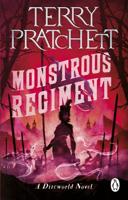
A beautiful blend of the absurdity of military and gender roles.
Polly Perks signs up for the Borogravian military, hoping to find what happened to her brother Paul. Initially fearful of being discovered, she gradually discovers that more and more of the people around her are women pretending to be men. Her companions include an “Igor” who’s more practiced at medicine than warfare, a vampire who craves coffee rather than blood, and Sergeant Jackrum, a crafty and protective leader of legendary status.
The ragtag band of misfits enjoys a successful military career, inadvertently capturing the prince of an adversary, earning a dangerous reputation as the “Monstrous Regiment” after their escapades are printed in a newspaper, and capturing a supposedly impregnable fortress after pretending to be washerwomen. Their unexpected success leads to a brief outbreak of peace between Borogravia and its neighbours, and a better future for all the women involved.
I was slow to warm to this book, but then I really got into it. It’s a story about resisting the expectations placed upon you – whether that’s as women in an ultra-conservative society, or as soldiers sent as cannon-fodder in a jingoistic war that can’t be won.
I’ve often heard that Terry Pratchett had a more nuanced understanding of gender than many modern writers; I’m starting to see where that sentinent comes from. It’s a refreshingly relaxed take on crossdressing and breaking gender norms.
I’m still not sure I want to read the entire Discworld series, but I’m glad I read this standalone story.
Quotes and highlights
Page 10, Polly thinks about how to walk as a man, in a scene that reminds me of my own experiences of gendered physicality:
Forget you were ever Polly. Think young male, that was the thing. […] Then there was the young male walk to master. At least women swung only their hips. Young men swung everything, from the shoulders down.
Page 11, a rather colourful but sad description of Plün:
She could walk down through the pine forests to Plün. The cart would have to stop there for the night, but the place was one of those nowhere villages that existed only in order to avoid the embarrassment of having large empty spaces on the map. No one knew her in Plün. No one ever went there. It was a dump.
Page 128, after they capture a group of enemy forces, and Polly reflects on the last few days:
It had been hard, very hard, to force herself to swing that cudgel. But once she had done it, it had been easy. And then she’d felt embarrassed about being caught in a petticoat, even though she had her breeches on underneath. She’d gone from boy to girl just by thinking it, and it had been so … easy. She needed some time to consider this. She needed time to think about a lot of things. She suspected that time was going to be in short supply.
Page 176 explains the Igors, a group of incredibly capable healers who treat the body like most people treat clothing:
Igors sometimes passed through Munz, although technically they were an Abomination in the eyes of Nuggan. It had seemed to Polly that using bits of someone who was dead to help three or four other people stay alive was a sensible idea, but in the pulpit Father Jupe had argued that Nuggan didn’t want people to live, he wanted them to live properly. There had been general murmurs of agreement from the congregation, but Polly knew for a fact that there were a couple of people sitting there with a hand or arm or leg that was a little less tanned or a little more hairy than the other one. There were lumberjacks everywhere in the mountains. Accidents happened, fast, sudden accidents. And, since there were not many jobs for a one-armed lumberjack, men went off and found an Igor to do what no amount of prayer could manage.
The Igors had a motto: What goes around, comes around. You didn’t have to pay them back. You had to pay them forward, and that, frankly, was the bit where people got worried. When you were dying, an Igor would mysteriously arrive on the doorstep and request that he be allowed to take away any bits urgently needed by others on his ‘little litht’. He’d be quite happy to wait until the priest had gone and, it was said, when the time came he’d do very neat work. However, it happened quite often that when an Igor turned up the prospective donor took fright and turned to Nuggan, who liked whole people. In which case the Igor would quietly and politely leave, and never come back. He’d never come back to the whole village, or the whole lumber camp. Nor would other Igors. What goes around comes around – or stops.
Page 253, Igorina talks about gendered expectations of Igors that mirrors human medicine:
‘The clan isn’t very … keen on girls getting too involved in the Great Work, said Igorina, looking downcast. ‘“Stick to your needlework”, my mother keeps saying. Well, that’s all very fine, but I know I’m good at the actual incisions as well. Especially the fiddly bits. And I think a woman on the slab would feel a lot better about things if she knew there was a female hand on the we-belong-dead switch. Tho I thought some battlefield experience would convince my father. Soldiers aren’t choosy about who saves their lives.’
Page 259 has a lovely grammatical image:
‘[The Duchess] says it will be all right for us not to wear our dimity scarves,’ said Wazzer.
‘What? Oh. Good,’ said Polly.
‘But only because we are serving a Higher Purpose,’ said Wazzer. And, just as Blouse could invert commas, Wazzer could drop capital letters into a spoken sentence.
Page 278 makes Ankh-Morpork sound like experienced software engineers:
Heinrich had a reputation locally for cunning, but Ankh-Morpork had overtaken cunning a thousand years ago, had sped past devious, had left artful far behind and had now, by a roundabout route, arrived at straightforward.
Page 332, Wazzer communing with the Duchess gives us a hint of where Jackrum is going, in a lovely bit of foreshadowing:
‘The Duchess says your path takes you further,’ said Wazzer.
‘Oh yeah?’ said Jackrum jovially. ‘And where’s that, then? Somewhere with a good pub, I hope!’
‘The Duchess says, um, it should lead to the town of Scritz,’ said Wazzer. She said it quietly while the rest of the squad were laughing, less at the comment than as a way of losing some of the tension. But Polly heard it.
Jackrum really, really was good, she thought. The fleeting expression of terror was gone in an instant. ‘Scritz? Nothing there,’ he said. ‘Dull town.’
‘There was a sword,’ said Wazzer.
Jackrum was ready this time. There was not a flicker of expression, just the blank face that he was so good at. And that was odd, Polly thought, because there should have been something, even if it was only puzzlement.
I love this description of prison guards on page 369:
They were not put into a dungeon, although they were marched past plenty. There were lots of bleak stone corridors, lots of heavy doors with bars and lots and lots of bolts, and lots of armed men whose job, presumably, only became interesting if all the bolts disappeared.
Page 452, Polly has thoughts on clothing:
Jackrum said nothing but, as Polly would have predicted, pulled his crumpled bag of chewing tobacco out of his pocket. She slipped a hand in her own pocket and pulled out a small packet. Pockets, she thought. We’ve got to hang on to pockets. A soldier needs pockets.
And shortly after, she tells Jackrum she knows his secret:
‘Oh, I thought, “What can I give the man who has everything?” and that was all I could afford,’ said Polly. ‘But you don’t have everything, sarge. Sarge? You don’t, do you?’
She sensed him freeze over.
‘You stop right there, Perks,’ he said, lowering his voice.
‘I just thought you might like to show someone that locket of yours, sarge,’ said Polly cheerfully. ‘The one round your neck. And don’t glare at me, sarge. Oh, yeah, I could walk away and I’d never be sure, really sure, and maybe you’d never show it to anyone else, ever, or tell them the story, and one day we’ll both be dead and … well, what a waste, eh?’
Jackrum glared.
‘Upon your oath, you are not a dishonest man,’ said Polly. ‘Good one, sarge. You told people every day.’
Around them, beyond the dome, the kitchen buzzed with the busyness of women. Women always seemed to be doing things with their hands – holding babies, or pans, or plates, or wool, or a brush, or a needle. Even when they were talking, busyness was happening.
‘No one would believe yer,’ said Jackrum, at last.
‘Who would I want to tell?’ said Polly. ‘And you’re right. No one would believe me. I’d believe you, though.’
Jackrum stared into his fresh mug of beer, as if trying to see the future in the foam. He seemed to reach a decision, pulled the gold chain out of his noisome vest, unfastened the locket, and gently snapped it open.
‘There you go, he said, passing it across. ‘Much good may it do you.’
After Jackrum explains that he, too, is a woman, has been looking after women pretending to be men for most of his military career, and has a family he left behind:
Polly let that pass, but said: ‘You don’t want to go back and see your grandchildren?’
‘Wouldn’t wish meself on him, lad,’ said Jackrum firmly. ‘Wouldn’t dare. My boy’s a well-respected man in the town! What’ve I got to offer? He’ll not want some fat ol’ biddy banging on his back door and gobbing baccy juice all over the place and telling him she’s his mother!’
Polly looked at the fire for a moment, and felt the idea creep into her mind. ‘What about a distinguished sergeant major, shiny with braid, loaded with medals, arriving at the front door in a grand coach and telling him he’s his father?’ she said.
Jackrum stared.
‘Tides of war, and all that,’ Polly went on, mind suddenly racing. ‘Young love. Duty calls. Families scattered, Hopeless searching. Decades pass. Fond memories. Then… oh, an overheard conversation in a bar, yeah, that’d work. Hope springs. A new search. Greasing palms. The recollections of old women. At last, an address—’
‘What’re you saying, Perks?”
You’re a liar, sarge,’ said Polly. ‘Best I’ve ever heard. One last lie pays for all! Why not? You could show him the locket. You could tell him about the girl you left behind you …’
Page 459, at the end of their conversation:
‘Perks!’ said Jackrum, as she reached the door. Polly stepped back into the room.
‘Yes, sarge?’
‘I… expected better of ‘em, really. I thought they’d be better at it than men. Trouble was, they were better than men at being like men. They do say the army can make a man of you, eh? So … whatever it is you are going to do next, do it as you. Good or bad, do it as you. Too many lies and there’s no truth to go back to.’
Page 469, when Polly has been promoted to sergeant and returns to the military, repeating a line she got from Jackrum:
There was a guard on the ferry. He eyed her nervously as she led the horse aboard, and then grinned. ‘Morning, miss!’ he said cheerfully.
Oh, well… time to start. Polly marched in front of the puzzled man.
‘Are you trying to be smart?’ she demanded, inches from his face.
‘No, miss—’
‘That’s sergeant, mister!’ said Polly. ‘Let’s try again, shall we? I said, are you trying to be smart?’
‘No, sergeant!’
Polly leaned until her nose was an inch from his. ‘Why not?’
The grin faded. This was not a soldier on the fast track-to promotion. ‘Huh?’ he managed.
‘If you are not trying to be smart, mister, you’re happy to be stupid!’ shouted Polly. ‘And I’m up to here with stupid, understand?’
‘Yeah, but—’
‘But what, soldier?’
‘Yeah, but … well … but … nothing, sergeant, said the soldier.