Sistersong (2021)
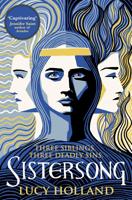
The three children of King Cador carve different paths for their lives, with Saxons at the door and magic in their blood.
Three months ago I read Song of the Huntress by the same author; this book uses the same system of magic, but is set in a different time. (I think it’s several centuries earlier, but it didn’t really matter.)
We follow the three children of King Cador of Dumnonia – Keyne, Riva, and Sinne. As with Huntress, the book alternates between their points of view, and we often see the same scene from more than one perspective. Although they all believe their fate is predetermined, as daughters of a king, they have hopes and dreams beyond that, and the book sees their lives set on very different paths.
I enjoyed this more than Huntress, and I got into it more quickly. I preferred having three perspectives that are immediately intertwined – rather than waiting for them to come together – and the contrast between three so supposedly-similar characters works well.
I was especially drawn to Keyne and the magician Myrdhin/Mori, who are clearly written to be transmasc and genderfluid – I love how well it integrates its themes into a historic setting where the words “trans” and “gender” are never uttered, but still recognisable. Keyne has lots of small moments of gender euphoria, recognition, and acceptance, which made me smile every time.
The plot is nothing remarkable, and followed predictable beats. The blurb tells me it’s based on an old British folk ballad “The Twa Sisters”, which I’d never heard of – but my lack of knowledge didn’t diminish from my enjoyment, and I never felt I was missing out.
Another solid bit of mythological fiction.
Plot summary
Our three perspectives are the children of King Cador and Queen Enica:
- Keyne has no interest in being seen as a king’s daughter or as a woman, and frequently dresses in man’s clothes.
- Riva works as a healer, but is unable to heal the severe burns she received as a child, which left her with a severely damaged hand and foot.
- Sinne is the youngest daughter, who is the least distinct at the beginning of the book, but develops as the book goes on.
The land has been abandoned by the Romans and there are Saxons on their doorstep. When they were younger, they worshipped gods like Brigid, and Cador could channel the magic of the land – but the priest Gildas is trying to convert the kingdom to Christianity, and pagan magic is taboo.
When Keyne sneaks out of the castle, he meets the magician Mori (or sometimes Myrdhin), who trains him in swordsmanship and other traditionally masculine pursuits. He’s gradually learning about the magic of the land, and how to channel it to defend the kingdom – as Cador once did. He’s also accepting his masculine identity, and being seen as a man by the people around him.
Riva uses herbs and potions to heal the people, but her power is waning as the kingdom turns its back on magic. She falls in love with a visiting warrior Tristan and this drives a wedge between her and her sisters, who distrust him.
Sinne has visions and the powers of a Seer, but realises her visions are actually memories and experiences of Riva – including being burnt by the wildfire as a child. She warns Riva about Tristan, who interprets it as childish jealousy. Her affection falls on Os, a mute warrior who travels with Tristan and communicates non-verbally.
When the harvests start to fail, Cador leads a group of men to a nearby settlement which has been abandoned, to gather supplies. Keyne realises it’s a Saxon ambush, and travels out with his girlfriend Gwen to warn the men. He arrives just in time, but not before Cador is grievously injured.
Returning to the castle, Keyne uses magic to defend the kingdom. Riva and Sinne have a fight over Tristan, which leads to Sinne falling in the river. Keyne and Myrdhin preserve Sinne’s soul and place it in a harp made of bone, where she can sing – and she reveals that Riva is pregnant with Tristan’s child. Cador succumbs to his injuries, but not before appointing Keyne as his heir – who renames himself as King Constantine.
The Saxons attack, and Tristan is revealed to be the son of their king, Cynric. He infiltrated the kingdom as a spy, and Riva gave him a lot of crucial information, including a secret passage in and out of the city. Cynric and Keyne fight, and only Riva’s intervention avoids them killing each other – she threatens to commit suicide to prevent further bloodshed.
Constantine remains king of Dumnonia and restores magic to the land.
Riva leaves with Tristan to live in the Saxon kingdom, never to return.
Sinne is whisked away by Os to see the world. Years later, Constantine and Myrdhin will stand on the shores of the sea and release her soul.
The three sisters, so close at the start of the book, are so very far apart by the end.
Quotes and highlights
Chapter 1 “Keyne” captures the prejudice that comes from being visibly different (page 6):
I make my way to the workshop, feeling the holdsfolk’s customary stares as I pass. The brideog is coming apart in my hands. I don’t know why I care, except that she’s an antidote to Christ and his earnest suffering. I am tired of being called sinful. Half my father’s hold already thinks me so. I need no help from Gildas and his followers.
Chapter 3 “Sinne” describes the sense of a Christian church displacing their gods (page 24):
The church feels oppressive. It wasn’t always a church, just a big storehouse Gildas blessed and called a church. Passing into its shadow, I realize all our old festivals take place out of doors. When we look up from our dancing or feasting, it’s to see the sun or stars above us. Now when I look up, all I see is the suffering, benevolent face of Christ hanging over us like a thunderhead.
In Chapter 12, Keyne discovers that they’re not the only person whose lived experience doesn’t match their birth gender:
I gesture at the vase and the golden cup beside it. ‘Tell me about the Enarees.’
‘Have you heard of the Scythians?’
‘Yes,’ I say to the cup after a second’s pondering, still not turning to face Mori. ‘I think Herodotus said they were a tribe notable for their warriors?’ I pause, feeling a flicker of a smile. ‘Some of them were women, too.’
‘They undoubtedly were.’ Mori sounds pleased. ‘That old fool managed to get some things right. But he was unforgivably fanciful when it came to the Enarees. Simply put, they were Scythian shamans, men who donned feminine dress and did not conform to either sex.’ Her voice reaches me across a distance, as if she’s speaking from a land well beyond our rocky shores. ‘And they are not the only ones. The followers of the goddesses Cybele and Astarte are also known to have transcended their given sex.”
My mouth dries. I sit absolutely still. ‘How is that possible?’
‘Because their worship gave them a space in which to be themselves. And they did whatever was necessary to feel like themselves, to show the world who they were. They weren’t forced to abide by what the Christian Church now considers male and female.’
‘Were?’ I ask. ‘So they’re not around today?’
‘The priests of Cybele were once politically powerful. But that ended when Rome officially adopted the Christian religion.’ I feel her eyes on me again. ‘And the arms of that Church are long and stained with the blood of people they do not understand.’ She sounds sad and angry too, a darkness of tone that suggests a darker memory. ‘The point is, though: you are not alone.’
I whip around, heart pounding. ‘How … What do you know of me, of my life?’
‘Just what I know of mine,’ Mori says. There is no condemnation in her, only acceptance; I don’t know whether I’m ready for it. I’ve become so used to hiding, to being constantly on the defensive. I never dreamed I’d tell someone my truth and that they’d react without fear or disgust. It is too much to take in.”
In chapter 14, Tristan tells Riva not to be ashamed of her injuries (page 114):
‘I’ve seen worse injuries, Riva,’ Tristan says. Perhaps it is his use of my name that makes me look up. ‘It isn’t ugly. It’s like a battle scar. And you are no more or less because of it. In fact I’d say you are more for learning to live with the use of a single hand, where everyone else has two. The world can be an unforgiving place. You must have been strong to weather it.’
In the start of chapter 15, Keyne describes something that feels very genderfluid (page 116):
I think of her as Mori more often than Myrdhin. I suppose it’s because she was Mori when I first met her, as a lost child in the woods. But I see both now, and can hear one in the other’s words. It’s comforting to know there is someone so near who might understand me. Someone unafraid to be who they are.
And later in the same chapter, as Mori dismisses Keyne (page 121):
‘It’s dawn and you’ll be missed, boy. Get going. We’ll speak again.’
I’m halfway across the clearing before her words catch up with me. I look back at the closed cottage door. Boy, she said. Despite Mori’s warning and her elusive talk of war, I find myself smiling.
In chapter 27, Sinne realises that she’s only just seeing Keyne for who he is (page 205):
‘Let’s go then.’ Before I can think of a suitable response, she’s pulling me along in her wake like so much flotsam. Her grip on my arm is almost painful and I find myself remembering Beltane – and Myrdhin’s words. He is who he is. The world cannot change that and neither can you.
He is who he is.
I look sidelong at Keyne. What is the difference between a girl in boy’s clothes and a boy in boy’s clothes? Huge, I realize, for Keyne. It goes deeper than clothing – that is just the thing we see. Is this what she’s been trying to tell us all these years? No wonder she confided in Myrdhin. We haven’t been listening at all. Still aren’t listening. The understanding hits me as an almost physical pain.
In chapter 29, Keyne is reminded that the church’s views on trans people are about the same as trhey are today (page 219):
‘Our God,’ Gildas corrects with a frown. His long fingers stroke the cover of his codex. ‘The Saxons are sent to test us, to test our faith. They are not a godly people. They do not belong here.’ He speaks his next words slowly, as if feeling out their truth. ‘I agree. Spilling the blood of heathens is a worthy cause.’
He called me heathen too once. So he considers Myrdhin and me no better than our enemies, slaughterers of innocents. I can’t say I’m surprised, but it makes my fists clench.
But Myrdhin offers a more positive note later in the same chapter (page 221):
Again, that gaze is upon me. ‘You have grown, Keyne,’ Myrdhin says in Mori’s voice. ‘Soon you’ll be needing another name.’ I blink at the person beside me. ‘A name?’ ‘You will find the world eager to push them on you. But the only names that matter are the ones we take for ourselves.’
Keyne discusses gender again with Gwen in chapter 31 (page 221):
Gwen is quiet a moment. ‘It’s as if by fighting, a woman is no longer a woman. In their eyes.’
“I still. The hand holding the dagger falls to my side as I stare at her. It’s because her words so closely echo something Mori said to me early on, after she explained about the Enarees and the Amazons. A woman can fight and is no less a woman. A man can be a woman. A woman can be a man. And then there are those who choose to be both or neither. Do you see now, Keyne, how foolish are the names we force on people before they’re even able to speak? I remember the way her brows came together. Your magic threatens Gildas much less than who you are – as a person. I fear this god of his is no fly-by-night. He is here to stay and people like you and me will have to fight all the harder to be heard.
‘But that does not mean we will be silent,’ I whisper to myself.
If Gwen hears me, she does not reply. But she does step closer to lay a hand on my arm. ‘Thank you for showing me what you know,’ she says. She looks very serious in that moment and I feel it’s not just swordplay she means.
In chapter 34, Sinne sees Keyne after he returns from the trip to prevent the Saxon ambush (page 273):
Keyne is a shadow in the doorway. Tall, armoured, the glint of weapons catching the dying daylight. I cannot call this person my sister. It isn’t the warrior garb alone; the word simply doesn’t fit. Perhaps it never has and we just didn’t see or want to see. I remember my words to Riva. Perhaps Keyne left so we could grow new eyes in the time he’s been gone. I cannot stop looking and my heart patters in my chest.
Riva witnesses Cador banishing Myrdhin in chapter 41, after he presents Sinne in the form of a bone harp, and it made me chuckle (page 343):
‘I will go,’ the magician tells the king, ‘if you insist upon it.’
‘I do.’ Cador gestures and four more guards surround Myrdhin. They seem reluctant to reach for him, though, and Myrdhin actually smiles.
‘Really, Cador. Do you think you could remove me from this hall if I did not agree to it?’
In the next chapter, Keyne gets a belated acceptance from his father, in the entirely predictable development that he’s named Cador’s heir (page 360):
‘You misunderstand.’ He beckons weakly to the nearest servant. ‘Summon lords Trachmyr and Paternus.’
The girl hurries away and I feel a furrow growing between my brows. Does he mean to strip me of what little authority I’ve gained amongst the lords, and the fighting men? My palms grow damp at the thought. I hadn’t realized how deeply I’d come to care for the responsibility of command: of drilling the men, checking defences, drawing up battle plans. My fear of having that taken away is visceral, as if Father is threatening to cut off a limb – some part integral to me.
‘Keyne.’ His voice breaks into my tortured musing. ‘I called you here … to make you my heir.’
Pure unfiltered shock roots me where I stand. But my father hasn’t finished. ‘The land hears you, as it once heard me. It would be folly to ignore it again. All I have goes to you. The kingship. The titles.’ He pauses to cough. ‘I only regret how poor your inheritance is, how you will have to defend it to the death. I am sorry to leave you such a burden.’
When the lords challenge Cador, he keeps them in line, and I love Keyne’s moment of realisation of how long the land will last (page 362):
‘Know your place.’ It is almost a bark and if I closed my eyes, I could half believe my father returned to full strength. But no illusions can survive this sickly firelight. Cador sinks back into his throne, spent. ‘And Keyne is no banchomarba, but my true heir, entitled to every right due a royal son.’
Shockingly, my eyes prickle, anger arrested in its tracks. I look at my father through a haze of disbelief. So do the lords. A hush falls. Outside, the wind howls on, uncaring of humans and the dramas they act out. It will blow across this land long after all of us are dust. After Dunbriga is dust. And other lives call this place home.
Throughout the book, Keyne/Constantine has been using a tunnel to escape the city and visit Mori, but they have to seal it ahead of the Saxon invasion. This is a gorgeous moment in chapter 43 (page 367):
Before me lies the tunnel, swamped as always in thorns. How many scars have they given me over the years? I stand and look, and I remember. Outside Dunbriga, I had felt free. Outside, I could be myself, unjudged. There was nobody who could strip, with a careless word, the layers I’d wrapped around myself – layers that had helped me survive in a world which pretended people like me did not exist.
When I pour earth into the passage, sealing it forever, I find myself whispering, ‘Thank you.’ It sounds like a goodbye to the person I was.
As everything is wrapping up in chapter 48, Constantine tells us what happened to Sinne (page 398):
She disappeared afterwards. Only I saw Os wrap her in lambswool and steal her away across the battlefield our home had become. I didn’t stop him. I don’t think anyone could have done. And Sinne had always wanted to see the world.
And he reflects on what has happened to each of them (page 399):
So neither of my sisters are here, several days later, to watch our father burn. Mother touches torch to pyre on the grey headland behind the great hall and, after looking long at Cador’s sunken face, I urge the flames through the wet logs. Should I weep? I find I cannot, the battle having washed me clean of tears. I am painfully aware, however, of the empty spaces on either side of me, where my sisters ought to stand. At that, I do cry again. Because fate pulled us apart in the cruellest of ways. But was it fate, really? Maybe it was simply the choices we made.