Song of the Huntress (2024)
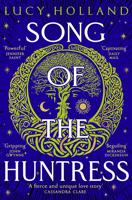
A love triangle set against the backdrop of early Britain and an invasion of undead kings that’s slow to start but finishes with a bang.
I enjoyed this book, but it took a long time to warm up. I wasn’t excited to keep reading until about halfway through, long after I’d have given up if this wasn’t a book club book.
The book has to do a lot of worldbuilding, because this isn’t an area of mythology that’s well known. (I knew basically none of it.) That always makes for a slow start, and the book struggles further by introducing two storylines at once: Ine and Æthelburg in the present, Herla in the past and the interim.
I wonder if I might have enjoyed it more if I met Ine and Æthelburg first – both of whom regard the Otherworld as a pagan story with no basis in reality – and only later meet Herla once the present timeline is established. It would give the two timelines more space to breathe, and intrduce some fun ambiguity between the myth and the reality.
I really enjoyed the love triangle between Ine, Æthelburg, and Herla, and the way it ends. The love and jealousy between them felt messy and meaningful, and I like how it wrapped up. Ine and Æthelburg’s marriage has issues, but they talk it out rather than giving up.
The book suffers for assuming too much knowledge from the reader, and I felt like I was missing out at several points. I know the name “Boudica”, and the book is keen to draw parallels between her and her Æthelburg, but I know so little that it didn’t really land. Compare to The End Crowns All, which leans on the Trojan Horse and deliberately subverts the well-known narrative to build suspense.
Overall I enjoyed this and I applaud it for exploring a different area of mythology. I’m glad I pushed through and got to the ending, which elevates the whole thing.
Plot summary
The book is told from the perspective of three characters: King Ine of Wessex, his wife Æthelburg, and Herla, an Iceni warrior who was cursed to become Lord of the Hunt and reap souls.
Ine and Æthelburg have been married for a decade, but never had a child – Ine has almost never been intimate with her, because he doesn’t experience sexual attraction. She takes the brunt of the blame, with the court believing it’s her fault for not bearing a child.
They’re engaged in war with Dumnonia, kingdom of the Britons, and both take calculated risks early in the book. Æthelburg deliberately destroys a Wessex fortress to prevent it being captured; while Ine allows Geraint, the king of the Britons, to enter Wessex with a small force, for the sake of some as-yet-unknown mythical quest.
Both these decisions are challenged by Ingild, Ine’s younger brother and heir presumptive to the throne. He ambushes Geraint, captures his son Cadwy, and stirs dissent against Ine and Æthelburg.
Meanwhile, Herla is an Iceni warrior who marched with Boudica, but when the tide turned against them, she made a deal with Gwyn ap Nudd, king of the Otherworld. He offered her power, but it was a trap: he cursed her to be Lord of the Hunt, and reap souls for centuries. When she finally regains her sense of self, Boudica and the Iceni are long since gone.
She leaves her sisters in the Hunt and travels to the mortal world in disguise, where she meets Æthelburg. Herla realises that Otherworld forces are at work, trying to kill everyone with Dumnonian royal blood – who would have the power to threaten Gwyn ap Nudd. Those forces killed Geraint, and now they’re going after Cadwy.
The Otherworld is a fairy tale to Ine and Æthelburg, but they both become to believe it as supernatural events occur around them – Ine seeing dead kings walking, Æthelburg witnessing men struck down by unnatural forces.
Æthelburg reminds Herla of Boudica, and the two become romantically entangled – Æthelburg still unsure of why Ine won’t be intimate with her, wondering if he’s been unfaithful while she was away at battle, and if their marriage is over.
Ine realises that he has the Dumnonian blood, and has the power to defeat Gwyn ap Nudd – and unite the kingdoms of Wessex and Briton. When Ingild accuses him of being a heathen, he flees the capital and rallies an army; Æthelburg does similar.
Gwyn ap Nudd tries to bargain with Herla; first with Æthelburg and then her sisters. If she gets out of his way, he will let her be happy with the people she cares about; otherwise he will make them suffer. She wonders why he bargains, and realises that he didn’t create her curse – he transferred his duty to her. He is meant to be reaping souls, and she can make him take the power back.
In a climactic battle, Ine and Æthelburg together drive back the Otherworld forces, and Herla forces Gwyn ap Nudd to retake his duty. She dies on the battlefield, and in an epilogue we see her walking in the Otherworld afterlife. Ine and Æthelburg return home, and agree to find a new way forward with their marriage.
Favourite quotes
P244, when Æthelburg goes to find Herla and meets her sisters in the Hunt:
‘You are a warrior?’ Senua asks; the woman Gelgéis introduced as her blood sister. When Æthel nods, she leans forward, elbows on her knees. ‘You have come here, claimed your rights as a guest and we have fed you. Will you pay the debt with a story? Tell us of a battle you have fought?’ She grins. ‘A great victory.’
Æthel blinks. Not once has she been asked such a question. Only with Ine has she ever sat down and dissected her fights. The gesths are interested in the outcome alone. As if the battles won themselves. Despite the bitter thought, she finds herself grinning too. Using a skewer, Ethel draws three lines in the dirt, marking her archers with a cross, and the start and end positions of her shield wall. Her opponent in the fight had been Uhtric, another upstart exile with designs on the throne. Æthel pushes the twin shames of Tantone and Gifle aside, buries the thought of her losses at Sceaptun. So engrossed is she in recounting the battle, fushed at the memory, bloody and bright, that she momentarily forgets where she is and who she is talking to.
P264, when Herla explains what Gwyn ap Nudd offered her, there’s a gorgeous phrase (emphasis mine):
‘At what cost?’ Corraidhín asks.
‘That I continue to lead the Hunt every moon. That I let him do whatever he wishes to this land?’ Her heart gives a sick thump of longing. ‘He will give me Æthelburg if I agree.’
‘And you are tempted. I do not blame you,’ Corridhin adds before Herla can make a doomed attempt to deny it. ‘But his offers are so drenched in honey that it’s impossible to taste the poison beneath.’
P269, a passage that reminds me of myself (emphasis mine):
‘I have not been drinking half the night,’ the queen replies loftily then ruins it with a hiccup. The women around her chuckle, and Æthelburg shakes her head as if to clear it. ‘I can’t waste time on sleep.’
‘Then sleep while we ride. I will not let you fall.’ Corraidhín glares, but Herla pretends not to see. Æthelburg’s expression is hidden in her cloak, as she throws it around herself.
Herla whistles. Her horse reforms from the darkness and she remembers, abruptly, that his coat used to shine. Does he miss the herd? Life on the meadow seas of Annwn? Mounted, she extends a hand to Æthelburg and the queen lets Herla pull her up. ‘I will not sleep,’ she says in the stubborn tones of someone fighting that very urge. It takes all of five minutes before her head slumps against Herla’s chest and her breathing softens.
P385, when Herla asks Æthelburg to run away with her:
‘Where would we go?’ Æthelburg asks eventually and Herla blinks.
‘Do you mean it?’ She holds the queen’s hands tight. ‘Despite your kingdom, your people… despite your husband?’
Æthelburg draws a shivering breath. ‘I… maybe. When this is over. When I know they are safe. She closes her eyes. ‘I have made the best of the life and privilege I have been given. I am proud of my achievements as queen.’ She opens them. ‘When I found Ine the night Geraint died, I thought he was dead too, and it hit me. How awful my life would be as a widow. Who would remember the sacrifices I made, those achievements I was so proud of? I would live out my years in a loveless place. But you…’ Her voice breaks. ‘You make me feel loved. At your side, I would never have to fear being alone. It is very hard not to want that.’
P393, when Herla is dying in Æthelburg’s arms, we get a lovely explanation of Æthelberg and Ine’s love:
The woman in her arms laughs softly, sadly. ‘It is time for me, Æthelburg. Although I have no right to ask … is it him you stay for?’
Inside her are memories; those she cherishes and those she yearns to forget. But that, Æthel realizes, is what sharing a life is. ‘We choose to love anew every single morning,’ she says, catching one of Herla’s tears on her fingertip. It glints like the rarest pearl, and somehow it comforts her, as if their tears have the power to bind them together. ‘Some mornings are more difficult than others. Yes, I stay for him. But more than that – I stay for me. This is where I am supposed to be. This is who I am.’ She turns her head to look up at the hilltop. I have no special power in me, no command over the land or its people other than being their queen, but that is what I will continue to be, as long as I live. ‘As for what comes after –’ she smiles through her tears – ‘only the fates know’.
And immediately after, Herla talks to the “scop” Emrys, and we get some lovely afterlife imagery:
Herlas own smile has faded. ‘You humble me, Æthelburg. Washed clean of pride indeed.’ She bows her head. ‘This is a fitting end for the story I started.’
‘It is not the end,’ a voice says.
The storyteller, Emrys, stands over them. Looking upon Herla, their face is unexpectedly gentle. ‘Beyond the seven castles and the summer stars. Beyond the lip of night, in the dawn that is forever, they wait for you.’
Herla draws a pained breath, as if the air has become too heavy for her to breathe. ‘My sisters?’
‘Samhain.’ Emrys’s eyes are a sky, and in that sky is another and another, leading back to some distant beginning. ‘I am certain that you can find your way to the shore.’
‘I know you now,’ Herla murmurs, her own eyes fixed upon Emrys … or on a place just beyond. For a moment, Æthel can hear the sway of the sea. ‘I will find it. I will find them.’
On page 397, when the Otherworld forces have been defeated:
In the wake of the Wild Hunt, a few flakes of snow drift down. One lands on her lips, and Æthel tastes winter. ‘She asked me to come with her,’ she hears herself say, staring at the place where she cradled Herla in her arms. ‘She asked me to come, so that she didn’t have to go alone.’ Her knees hit the cold ground as agony saps the last of her strength. ‘Oh God, what have I done?’ And she cannot care, in that moment, what Ine thinks as she curls in upon herself. All she can feel is the chasm where her heart used to be, and all she can hear is the lonely song of the wind.
And the very end of the book, pages 405–6:
For the first time since Samhain night, warmth – true warmth – spreads through her. She shifts closer on the bed, so that Ine can put his arms around her. He kisses her hair and they lie like that, not speaking, for many minutes. It is early still. Few things move beyond the walls of their room. ‘I’ve missed you, Æthel,’ he murmurs against her. ‘So much. You don’t need to be a lone wolf, although I understand it is easier than constantly working to prove yourself to those who do not value you.’ His arms tighten. ‘I am sorry I did not speak up when I should have. You had to fight alone.’
‘You have had to fight alone too. I am sorry I believed you could not cope without me.’ Æthel is reminded unwillingly of her conversation with Herla. She had been right about many things. ‘I told myself that every battle must be fought with swords, and that you were weak for choosing other ways. That belief has made me very angry.’
‘Sometimes swords are necessary.’ He lets out an amused breath. ‘But not every door needs to be kicked in.’
‘Then again,’ Æthel mutters, thinking of Hamwic, ‘some doors do.’
‘Your judgement has always been impeccable on that account.’ A tremor, maybe laughter, goes through her, and she turns in his arms so that she can see his face. There is something new in his eyes besides the gold. ‘Æthel,’ Ine whispers. ‘You cannot help but cast a long shadow.’ He touches her cheek. ‘And even if I stand in it, I would be nowhere else.’ His finger traces a line from her temple to her jaw, thumb brushing a scar there, a faint white line. She remembers the day she got it. How he had been horrified at the thought of her bearing it forever. She remembers what she told him. My first mistake. It will remind me to make it my last.
Æthel has made many mistakes in the years since. If her scars must remind her of anything, it should be that mistakes are part of living. Her husband smiles gently at her, and she moves her hand to his chest. Beneath her fingers, his heart is quick and strong, the same determined beat as her own.