The Anatomy of Dreams (2014)
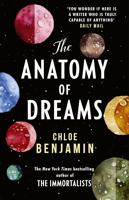
A psychological thriller that I enjoyed more once I realised it wasn’t the sci-fi suggested by the blurb.
I picked up this book because it sounded like a sci-fi novel – a mysterious professor, clandestine experiments, blurring the world between reality and dreams. The reality is more down-to-earth; it’s a psychological thriller about trust and love with no supernatural elements.
It’s a first-person narrative told by Sylvie, a young researcher who works as one of Dr Keller’s two assistants. His other assistant is Gabe, a boy she met at school who leaves unexpectedly, then she sees again while at college. Keller is doing experiments into lucid dreaming and deep sleep. Ostensibly he’s helping people with sleeping disorders, but Sylvie suspects he has ulterior motives.
The book jumps around in her timeline – Keller as a teacher at her school, meeting Gabe in college, working together as researchers as young adults, then confronting Keller years later when she discovers the truth. This helped my stay interested, because the non-linear storytelling creates intriguing gaps. Almost immediately I understood that something bad was going to happen between Sylvie, Keller and Gabe, but I had to keep reading to find out what.
Everything unravels when a former research subject is arrested for murder; somebody Keller turned away from the research. It makes Sylvie question his claims of “helping” their subjects, and it adds to a growing sense of distrust with Gabe. She’s horrified that their work might have unlocked somebody’s murderous insincts; the other two are less bothered.
While organising the paperwork, Sylvie discovers that she was an early research subject. She was an extremely lucid dreamer who fascinated Keller and Gabe, so they conspired to keep her close and study her further. She realises that her dreams might have been more than imagination, and people around her took advantage of her sleeping self – including her neighbour Thom, who she may or may not have slept with.
She leaves them both and returns to her parents, and resumes the life she had before joining the research. The research project continues to move around smaller and smaller universities, until it’s eventually disbanded. Years later, she confronts Keller, but the self-righteous encounter isn’t as satisfying as she’d hoped.
Once I realised this was a story of trust and love, I enjoyed it a lot more. There is a tiny amount of sci-fi – brief musings about whether dreams show us multiversal possibilities – but really this book is about three people and the relationships between them.
I didn’t dislike this book, but I struggled to read more than a few chapters at a time; it was a struggle to finish.
Quotes and highlights
Chapter 1 “Eureka, California, 1998”, page 17. I like this introduction to one of Sylvie’s school friends:
Hannah was the baby in a bright lineup of sisters – sisters who knew how to braid hair, who flattened cardboard boxes and slid down the hills that surrounded their father’s farm, and who handed down to Hannah a complicated mythology about boys in addition to old sweaters and winter jackets and bicycles.
Chapter 2 “Madiscon, Wisconsin, 2004”, page 19. I love this description of their travel, as Sylvie abandons college to join the research project:
Six years later, as Gabe and I drove a U-Haul from Fort Bragg, California, to Madison, Wisconsin, I found myself sorting obsessively through my memories of Mills and the years after I left. There was plenty of time on our drive, and more space: first the California redwoods, then the sliced-open rock of the Sierra Nevada and Utah’s red hills. In Colorado we saw rivers so glassy and clear they mirrored the land above them, so that the river ceased to be a river at all and instead became a double of the sky.
We looked at all this without talking; we felt as though it belonged not to us but to the natives and travelers who hiked those canyons by day and slept with the sun. We had forfeited our right to day by accepting a different offer.
Chapter 16 “Martha’s Vineyard, Massachusetts, 2010”, page 245. Sylvie has left Gabe and Keller behind, and enjoying her independence:
It isn’t so awful, being alone, not when you get used to it. Every decision’s my own. Whenever I like, I can stop at a gas station for cheap coffee or Slim Jims. If there’s a fruit stand, I’ll pull to the side of the highway – I keep the bags in the passenger seat, knotted to keep out flies – and sometimes I get out for a roadside attraction: the Angel Museum in Beloit, Wisconsin, or Amarillo’s Cadillac Ranch. Mostly, though, I try to make good time. That way, when I touch down for the night, it feels deserved.
Chapter 17 “Madiscon, Wisconsin, 2005”, page 265. Sylvie has fled the house after discovering the truth about the research, and runs into their neighbouiring train track:
I had pictured the majestic ferocity of old freight trains, the coal-black engine and husk of white steam. But this train was ramshackle and tired, with a child’s crude design: blunt wheels, wagons in sallow shades of orange and yellow and brown. The sides were sprayed with graffiti. The train itself seemed to howl in protest, condemned to carry these stories, for how to clean a train – a pressure washer, a sand-blaster? – and what would be the point, if the next night someone new came, spray paint in hand, to find the train’s canvas cleaned and ready?
Chapter 19 “Madiscon, Wisconsin, 2005”, page 278. Leaving them behind, Sylvie reflects on the future of the research project:
While in Berkeley, I followed [Keller] and Gabe from afar. They continued on for another two years, traveling like vagabonds from one college town to the next. They spent the fall after I left in Ann Arbor, the spring in Bloomington. From there, the universities became more and more obscure. After the 2005–2006 academic year, which they spent in a small New York college so far upstate that it bordered Canada, their work was no longer tied to any school at all!
I’ve often wondered how they felt in those final months, when the East Coast was just beginning to wake after a winter in hibernation. Were they filled with despair, so incongruous when the outside world was in bloom? Or did they surrender quietly? They must have known that their time had come and gone. As the twenty-first century continued, nobody wanted to learn how to live in their dreams - they just wanted to stay asleep. Out was the touchy-feely naval-gazing of the eighties and nineties; when gas prices were soaring, ice caps were melting, and resources were becoming thin, insurance was the best thing money could buy. You’ll Sleep Like a Baby, one mattress ad promised – and what was more attractive, more elusive, than that sort of ignorance, harder-won in adulthood but no less blessed?