Sheep at the station, trains on the road, and cracks in the boiler.
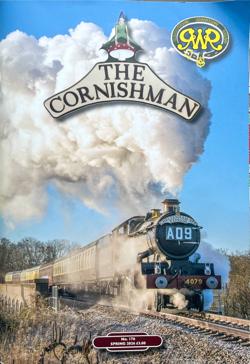
The Cornishman magazine is a magazine sent to members of the Gloucestershire Warwickshire Steam Railway (GWSR), a heritage railway in the Cotswolds. My granddad used to volunteer with the railway and still gives me a copy after he’s read it; these are my favourite parts from a recent issue.
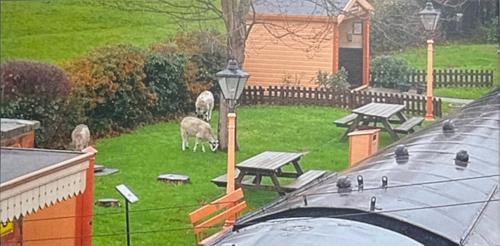
One autumn day, luckily not a running day, a call was received to help round up some sheep which had found their way into the station. No grass-cutting needed that week! But after the sheep had been safely removed, the incident prompt`ed a careful check of the fences.
Wooly helpers at Toddington. Photo by Peter Nash.
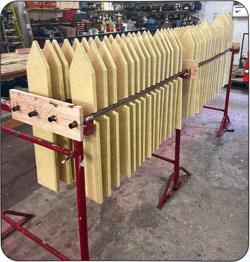
Chris Bambridge’s account of “Construction & Maintenance” (page 23) caught my eye, because it names a railway feature that I often see, but didn’t know the name of.
We are also becoming proficient in making dagger boards for station canopies where these have rotted away. Painting the individual components takes several weeks and will when installed be food for a significant period of time. Several station canopies are to be addressed.
On page 29, I was fascinated by Pete Mason’s explanation of how locomotive 35006 was transported to another railway for a gala event:
One of the main risks of transporting a steam locomotive by road is the process of loading the loco onto the road transporter. As the loco rises up the ramp, the weight is transferred off some wheelsets and onto others, greatly exceeding the loads that the springs are designed for. To avoid damage, we insist that stop blocks are placed to limit the movement of the axleboxes so that the weight of the loco doesn’t cause the springs to move beyond their limit. This transfers the weight of the loco directly to the wheels, without the springs exceeding their design load. These blocks have to ben removed again as soon as the loco is unloaded so that the loco is once again sitting on its own suspension.
At Kidderminster, access to the site is very restricted and the loco was delivered the opposite way round to what was required. Once the loco and tender had been coupled together, the loco was shunted onto the turntable. The crew then used the manual handles to crank the loco round so that it faced the desired direction – the first time the loco had been on a turntable since the 1960s.
The news was not so good for locomotive 7903, which John Cruxon explained on page 30:
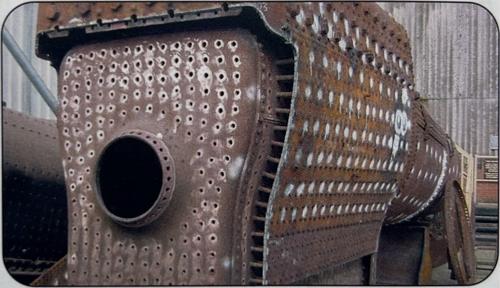
I am sure most volunteers and shareholders will have heard that 7903 has been withdrawn for overhaul following an unsuccessful boiler extension extension examination. [...]
To obtain that extension, the boiler had to undergo non-destructive testing of the firebox stays. These are the copper and steel rods, known as stays, that hold the inner copper firebox apart from the outer steel firebox. In normal service, when we wash out a boiler and test for broken stays, we tap them with a small hammer and listen for a clear ringing of "pinging" sound.
This test had been carried out and all stays appeared to be satisfactory. However, when the BES engineer carried out testing using electronic equipment, which sends a signal down each stay to confirm it is intact, five copper stays failed to register any indication, suggesting that they are broken.
This reminded me of the film Oh, Mr Porter! in which Will Hay plays a wheeltapper – using a hammer to test stays feels very similar.