Road signs in the Soviet union don’t have circular heads
Their heads are more a sort of rounded triangle shape, a bit like an oval or an egg.
Earlier this week, I saw a photo of a road sign that caught my eye. The original image is a stock photo that I can’t reproduce without a license, but here’s a freely available alternative that shows the same sign:
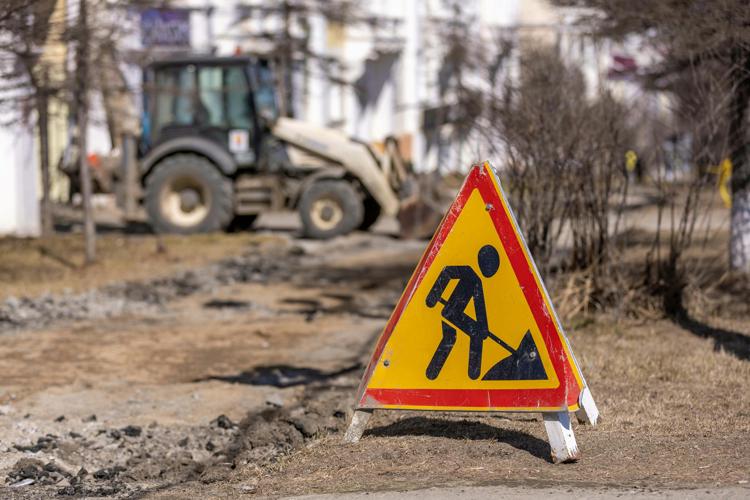
I understood the sign immediately. The details differ from the signs I’m used to, but it’s recognisably a “men at work” sign meant to warn you about ongoing roadworks.
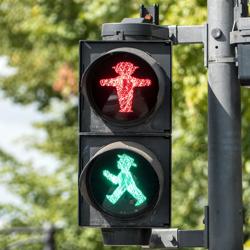
The man’s head is an oval or egg shape, which is a style I’d not seen before. I’m used to signs where the head is a perfect circle, or signs where the head is very distinct and stylised, like the Ampelmännchen seen at pedestrian crossings in Germany.
Writing this note, I realise there are road signs I’m familiar with that don’t have rounded heads, but I’d never noticed. For example, the UK’s “children crossing” sign is meant to depict a girl with a non-circular haircut, but I’d never noticed it before. (Although Margaret Calvert, the original designer, refreshed the design in 2016 to make the haircut more prominent. Perhaps that’s why I never noticed it.)
_August_2009_1x.jpg)
It took me a bit of searching, but I eventually learnt that the egg-shaped head in the original image is a design choice that goes back at least as far as the Soviet Union. Soviet road signs were specified by the GOST 10807-78 standard, released in 1980, and copies are available online.
This sign is entry 1.23 Дорожные работы (“men at work”). The same head shape appears in signs like 1.20 Пешеходный переход (“pedestrian crossing”) and 1.21 Дети (“children”).
I looked through the rest of the standard, and there are some other signs I enjoyed and would like to see when I’m driving: the adorable cow in 1.24 Перегон скота (“cattle drive”), the bugle in 3.26 Подача звукового сигнала запрещена (“sounding the horn is prohibited”), and the gently swaying tree in 6.11 Место отдыха (“resting place”).
These signs all look familiar even to non-Soviet drivers because of the Vienna Convention on Road Signs and Signals, which established international standards for road signs and images. The full text is available online, and Annex 3 includes symbols to be used on road signs. The detail was left to individual countries, but the broad shapes are meant to be consistent.
After the dissolution of the Soviet Union, road signs gradually diverged in the new countries. I found a cool website by Bartolomeo Mecánico, which collects photos of different road signs around the world, and there’s a page with examples of the men at work sign in former Soviet countries.