Static websites
A static website is a website that only uses HTML, CSS, and a bit of JavaScript. They can be saved and used as basic files, and they don’t require a special web server to use. I use static websites for tiny media archives, and this topic explores the technology behind that choice.
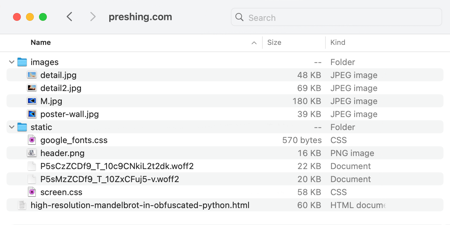
Building a personal archive of the web, the slow way
How I built a web archive by hand, the tradeoffs between manual and automated archiving, and what I learnt about preserving the web.
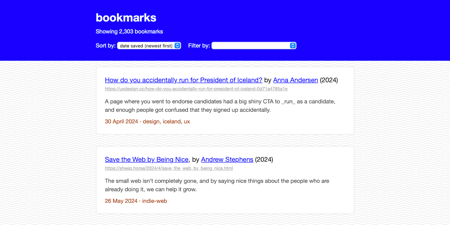
Creating a static website for all my bookmarks
To help me keep track of interesting links, I created a static website that keeps all my data locally. Why do I care about bookmarks, and how does my new site work?

How I create static websites for tiny archives
Start with a simple HTML file, then add features like templates, sorting, and filtering as they become useful.

Using static websites for tiny archives
I’ve been creating small, hand-written websites to organise my files. It’s a lightweight, flexible approach that I hope will last a long time.
Organising my cross-stitch patterns
A local static website lets me keep all my patterns in one place, so I’ll never lose a pattern again.
Using Playwright to test my static sites
Playwright is a testing library that lets you control a browser and check how the page is behaving, and it’s great for testing and scripting web apps.
Creating static map images with OpenStreetMap, Web Mercator, and Pillow
I made some simple map visualisations by downloading tiles from OpenStreetMap, then annotating the tiles with Pillow.
Adding auto-generated cover images to EPUBs downloaded from AO3
I built a handy tool to generate cover images for stories downloaded from AO3, making them easier to browse. Along the way, I learnt about how EPUBs work, the power of static sites, and some gotchas of async JavaScript.